This is some text inside of a div block.

Yes. Coral Care provides in-home speech, occupational, and physical therapy in Texas, including the Houston area, with no referral needed. Coral Care is in-network with most major plans, and self-pay is $250 for an evaluation and $125 per session.

This is some text inside of a div block.

Talk with your pediatrician. If your child is under 3, you can contact Texas Early Childhood Intervention (ECI) directly for a free evaluation, no referral needed. Children 3 and older can be evaluated through your local public school district.

This is some text inside of a div block.

Yes. Public libraries, nonprofit support communities, and local programs often offer free activities, materials, and family events. Our guide above lists options, and each organization can confirm what it currently offers.

This is some text inside of a div block.

Coral Care provides in-home speech, occupational, and physical therapy in Texas with no referral needed. Most families book an evaluation within 1 to 2 weeks, and Coral Care is in-network with most major plans. See insurance and payment details.

This is some text inside of a div block.

Ask about staff training, group size, and how the program handles sensory or behavior needs, and share your child's needs up front so staff can plan accommodations. A trial visit can help your child get comfortable.

This is some text inside of a div block.

Houston families can find support communities, adaptive recreation and after-school programs, and inclusive library programs. Our guide above lists options around Houston. Contact each program to confirm current schedules and eligibility.

This is some text inside of a div block.

Coral Care provides in-home speech, occupational, and physical therapy in Texas with no referral needed. Most families book an evaluation within 1 to 2 weeks, and Coral Care is in-network with most major plans. See insurance and payment details.

This is some text inside of a div block.

Learn your rights under IDEA, keep copies of evaluations and school communication, and put requests in writing. Parent training programs and advocacy organizations can help you prepare for IEP meetings.

This is some text inside of a div block.

Yes. Many Austin-area nonprofits, advocacy groups, and parent networks offer free classes, support groups, and information for families. Our guide above lists options, and each organization can confirm what it currently offers.

This is some text inside of a div block.

Coral Care provides in-home speech, occupational, and physical therapy in Texas with no referral needed. Most families book an evaluation within 1 to 2 weeks, and Coral Care is in-network with most major plans. See insurance and payment details.

This is some text inside of a div block.

Your school district's special education office can walk you through evaluations, IEPs, and your rights under the Individuals with Disabilities Education Act (IDEA). The Texas Education Agency also publishes parent guides on special education.

This is some text inside of a div block.

Austin families can turn to parent education programs, disability advocacy organizations, statewide parent networks, and local support groups. Our guide above lists options in the Austin area. Contact each organization directly to confirm current programs, eligibility, and costs.

This is some text inside of a div block.

Yes. A pediatric occupational therapist can help your child build tolerance for everyday sensory experiences and give your family strategies for outings. Coral Care offers in-home OT in Illinois, with no referral needed.

This is some text inside of a div block.

Ask for a quieter time slot, share your child's triggers ahead of time, and ask whether they can skip loud tools like blow-dryers or slow the pace. Many kid-focused providers will adjust when they know what helps.

This is some text inside of a div block.

Preview the place together with photos or a short social story, plan to arrive when it's quieter, and bring comfort items like noise-reducing headphones. When you arrive, find the quiet areas and exits so your child knows where to take a break.

This is some text inside of a div block.

Look for museums, theaters, and play spaces that offer sensory-friendly hours or performances, which usually mean lower sound, softer lighting, and smaller crowds. Our guide above lists therapist-picked spots around Chicago. Schedules change, so confirm dates and hours with each venue before you go.

This is some text inside of a div block.

Yes. A pediatric occupational therapist can help your child build tolerance for everyday sensory experiences and give your family strategies for outings. Coral Care offers in-home OT in Massachusetts, with no referral needed.

This is some text inside of a div block.

Ask for a quieter time slot, share your child's triggers ahead of time, and ask whether they can skip loud tools like blow-dryers or slow the pace. Many kid-focused providers will adjust when they know what helps.

This is some text inside of a div block.

Preview the place together with photos or a short social story, plan to arrive when it's quieter, and bring comfort items like noise-reducing headphones. When you arrive, find the quiet areas and exits so your child knows where to take a break.

This is some text inside of a div block.

Look for museums, theaters, and play spaces that offer sensory-friendly hours or performances, which usually mean lower sound, softer lighting, and smaller crowds. Our guide above lists therapist-picked spots around Boston. Schedules change, so confirm dates and hours with each venue before you go.

This is some text inside of a div block.

Yes. A pediatric occupational therapist can help your child build tolerance for everyday sensory experiences and give your family strategies for outings. Coral Care offers in-home OT in Texas, with no referral needed.

This is some text inside of a div block.

Ask for a quieter time slot, share your child's triggers ahead of time, and ask whether they can skip loud tools like blow-dryers or slow the pace. Many kid-focused providers will adjust when they know what helps.

This is some text inside of a div block.

Preview the place together with photos or a short social story, plan to arrive when it's quieter, and bring comfort items like noise-reducing headphones. When you arrive, find the quiet areas and exits so your child knows where to take a break.

This is some text inside of a div block.

Look for museums, theaters, and play spaces that offer sensory-friendly hours or performances, which usually mean lower sound, softer lighting, and smaller crowds. Our guide above lists therapist-picked spots around Austin. Schedules change, so confirm dates and hours with each venue before you go.

This is some text inside of a div block.

Yes. A pediatric occupational therapist can help your child build tolerance for everyday sensory experiences and give your family strategies for outings. Coral Care offers in-home OT in Texas, with no referral needed.

This is some text inside of a div block.

Ask for a quieter time slot, share your child's triggers ahead of time, and ask whether they can skip loud tools like blow-dryers or slow the pace. Many kid-focused providers will adjust when they know what helps.

This is some text inside of a div block.

Preview the place together with photos or a short social story, plan to arrive when it's quieter, and bring comfort items like noise-reducing headphones. When you arrive, find the quiet areas and exits so your child knows where to take a break.

This is some text inside of a div block.

Look for museums, theaters, and play spaces that offer sensory-friendly hours or performances, which usually mean lower sound, softer lighting, and smaller crowds. Our guide above lists therapist-picked spots around Dallas. Schedules change, so confirm dates and hours with each venue before you go.

This is some text inside of a div block.

Yes. A pediatric occupational therapist can help your child build tolerance for everyday sensory experiences and give your family strategies for outings. Coral Care offers in-home OT in Pennsylvania, with no referral needed.

This is some text inside of a div block.

Ask for a quieter time slot, share your child's triggers ahead of time, and ask whether they can skip loud tools like blow-dryers or slow the pace. Many kid-focused providers will adjust when they know what helps.

This is some text inside of a div block.

Preview the place together with photos or a short social story, plan to arrive when it's quieter, and bring comfort items like noise-reducing headphones. When you arrive, find the quiet areas and exits so your child knows where to take a break.

This is some text inside of a div block.

Look for museums, theaters, and play spaces that offer sensory-friendly hours or performances, which usually mean lower sound, softer lighting, and smaller crowds. Our guide above lists therapist-picked spots around Pittsburgh. Schedules change, so confirm dates and hours with each venue before you go.

This is some text inside of a div block.

Yes. A pediatric occupational therapist can help your child build tolerance for everyday sensory experiences and give your family strategies for outings. Coral Care offers in-home OT in Pennsylvania, with no referral needed.

This is some text inside of a div block.

Ask for a quieter time slot, share your child's triggers ahead of time, and ask whether they can skip loud tools like blow-dryers or slow the pace. Many kid-focused providers will adjust when they know what helps.

This is some text inside of a div block.

Preview the place together with photos or a short social story, plan to arrive when it's quieter, and bring comfort items like noise-reducing headphones. When you arrive, find the quiet areas and exits so your child knows where to take a break.

This is some text inside of a div block.

Look for museums, theaters, and play spaces that offer sensory-friendly hours or performances, which usually mean lower sound, softer lighting, and smaller crowds. Our guide above lists therapist-picked spots around Philadelphia. Schedules change, so confirm dates and hours with each venue before you go.

This is some text inside of a div block.

Keep the first visit short so it ends on a high note, go when it's quiet, and bring a snack and water. If your toddler could use more support with movement, play, or sensory needs, Coral Care offers in-home occupational and physical therapy in Massachusetts, with no referral needed.

This is some text inside of a div block.

Weekday mornings or right after opening are usually calmest, with fewer crowds and less noise. Hours and programs change often, so check the venue's website or call before you go.

This is some text inside of a div block.

Look for a space with a separate area for toddlers, manageable crowds, and a quiet spot to take a break. Smaller, age-specific spaces are often calmer for young children than large, mixed-age play centers. Our guide above lists therapist and parent picks to start with.

This is some text inside of a div block.

Keep the first visit short so it ends on a high note, go when it's quiet, and bring a snack and water. If your toddler could use more support with movement, play, or sensory needs, Coral Care offers in-home occupational and physical therapy in Texas, with no referral needed.

This is some text inside of a div block.

Weekday mornings or right after opening are usually calmest, with fewer crowds and less noise. Hours and programs change often, so check the venue's website or call before you go.

This is some text inside of a div block.

Look for a space with a separate area for toddlers, manageable crowds, and a quiet spot to take a break. Smaller, age-specific spaces are often calmer for young children than large, mixed-age play centers. Our guide above lists therapist and parent picks to start with.

This is some text inside of a div block.

Keep the first visit short so it ends on a high note, go when it's quiet, and bring a snack and water. If your toddler could use more support with movement, play, or sensory needs, Coral Care offers in-home occupational and physical therapy in Illinois, with no referral needed.

This is some text inside of a div block.

Weekday mornings or right after opening are usually calmest, with fewer crowds and less noise. Hours and programs change often, so check the venue's website or call before you go.

This is some text inside of a div block.

Look for a space with a separate area for toddlers, manageable crowds, and a quiet spot to take a break. Smaller, age-specific spaces are often calmer for young children than large, mixed-age play centers. Our guide above lists therapist and parent picks to start with.

This is some text inside of a div block.

Milestone guides describe typical development, but every child's path is individual. If your child has a diagnosis, their developmental team can help you understand what milestones are most meaningful in their context and what support makes sense.

This is some text inside of a div block.

Kindergarten readiness isn't all-or-nothing. Most children have areas of strength and areas that are still developing. A pediatric occupational therapist, speech therapist, or physical therapist can evaluate specific areas of concern and provide targeted support before the school year begins.

This is some text inside of a div block.

Some sounds are still developing at five — including r, l, s, sh, ch, and th. If your child's speech is mostly understandable but a few sounds are off, that's often within normal range. If overall intelligibility is low, or if you're hearing concerns from preschool teachers, an evaluation from a speech-language pathologist is worthwhile.

This is some text inside of a div block.

Yes, but the frequency and intensity should be trending down from the peak around 18-24 months. If tantrums are increasing, lasting very long, or becoming unsafe, an occupational therapist can help with emotional regulation strategies.

This is some text inside of a div block.

3-word sentences are the benchmark at 36 months. If your child is below that, reaching out to a speech-language pathologist for an evaluation is a reasonable and low-stakes step — it gives you information and, if needed, a plan.

This is some text inside of a div block.

Tantrums are developmentally typical at this age, but frequency and intensity vary a lot. If meltdowns are happening many times a day, lasting a long time, or becoming unsafe, an occupational therapist can help with sensory and emotional regulation strategies.

This is some text inside of a div block.

At 30 months, familiar adults should understand most of what a child says. If even you are having frequent difficulty understanding your toddler, or if strangers understand very little, a speech-language pathology evaluation is worth pursuing.

This is some text inside of a div block.

No. In-home therapy is in-person therapy that takes place in your home rather than in a clinic. The therapist is physically present.

This is some text inside of a div block.

In most cases, yes. Many insurance plans that cover in-person therapy also cover teletherapy.

This is some text inside of a div block.

At Coral Care, evaluations take place in your home and you are present throughout.

This is some text inside of a div block.

Speech and OT evaluations typically take 60 to 90 minutes. PT evaluations are often 45 to 75 minutes.

This is some text inside of a div block.

Some children develop greater sensory tolerance with therapeutic support. The goal of therapy is building tools to function well despite sensory sensitivities.

This is some text inside of a div block.

No, though they frequently co-occur. SPD can exist independently of autism.

This is some text inside of a div block.

Yes. School-based therapy and private therapy are not mutually exclusive.

This is some text inside of a div block.

No. Your child must separately qualify under Part B eligibility criteria, which many EI children do not meet — particularly if they've made significant progress.

This is some text inside of a div block.

You have rights. You can request an independent educational evaluation at the school district's expense, file a state complaint, or request mediation or a due process hearing. You are an equal member of the IEP team and do not have to accept a determination you disagree with.

This is some text inside of a div block.

Yes. An IEP and private in-home therapy are not mutually exclusive. Many families use both — supplementing what the school provides with additional sessions at home, especially when school-based frequency isn't sufficient for their child's needs.

This is some text inside of a div block.

An IFSP (Individualized Family Service Plan) is used in early intervention (birth to 3) and is centered on your family's routines and goals. An IEP (Individualized Education Program) is used in school-based special education (ages 3-21) and focuses on your child's educational needs. The shift from IFSP to IEP also means a shift from home-based to school-based services.

This is some text inside of a div block.

By law, transition planning must begin at least 90 days before your child's third birthday. Many EI programs start the process even earlier — up to six months out — to ensure evaluations are completed and an IEP is in place by the birthday.

This is some text inside of a div block.

No. Qualifying for early intervention doesn't guarantee an IEP. School districts use different eligibility criteria under Part B of IDEA, and some children — especially those who've made significant progress in EI — won't meet the threshold. If your child doesn't qualify, private therapy remains available.

This is some text inside of a div block.

Early intervention services stop on your child's third birthday. At that point, your child may qualify for school-based services through an IEP, or you can continue services through private in-home therapy like Coral Care. The transition doesn't have to mean a gap in care.

This is some text inside of a div block.

Yes. Coral Care provides in-home speech therapy, occupational therapy, and physical therapy for children across Massachusetts. Many families use private in-home therapy to bridge the gap after EI, supplement an IEP, or as their primary therapy option.

This is some text inside of a div block.

Once you give consent, the school district has 30 school days to complete the evaluation and 45 school days to hold the Team meeting and develop an IEP if your child is found eligible.

This is some text inside of a div block.

No. Massachusetts school districts use different eligibility criteria than the EI program. Many children who received EI services don't qualify for a school-based IEP, particularly if they've made strong progress. If your child doesn't qualify, private therapy remains an option.

This is some text inside of a div block.

A TPC is the required meeting between your EI team, the school district, and you that kicks off the age-3 transition. It must happen at least 90 days before your child's third birthday. At the TPC, the team reviews your child's current services and sets the timeline for evaluation and IEP development.

This is some text inside of a div block.

Massachusetts EI services end on your child's third birthday. Before that, your EI program refers your child to your local school district, which evaluates them for special education eligibility. If they qualify, an IEP is developed. If not — or if you want more than the IEP provides — private in-home therapy is an option.

This is some text inside of a div block.

Yes. Coral Care provides in-home speech therapy, occupational therapy, and physical therapy for children across Connecticut. Many families use it to bridge the gap after Birth to Three ends, supplement school-based services, or as a primary option when an IEP isn't available or sufficient.

This is some text inside of a div block.

No. Birth to Three eligibility doesn't carry over. The school district evaluates your child under different criteria, and some children who received Birth to Three services won't qualify for school-based special education. If your child doesn't qualify, private therapy remains an option.

This is some text inside of a div block.

After the transition conference, the school district conducts a domain review — a structured process to determine whether existing evaluations are sufficient or whether new assessments are needed before making an eligibility determination. You'll be asked to sign consent for any additional evaluations.

This is some text inside of a div block.

Call the Child Development Infoline at 1-800-505-7000. They can connect you with the Birth to Three program serving your area. There are 19 programs across the state.

This is some text inside of a div block.

Birth to Three services end on your child's third birthday. Your service coordinator initiates a transition to your local school district, which evaluates your child for special education eligibility. If they qualify, an IEP is put in place. If not, or if you want more support than the IEP offers, private in-home therapy is available.

This is some text inside of a div block.

Yes. Coral Care provides in-home speech therapy, occupational therapy, and physical therapy for children in New Hampshire. Many families use in-home therapy to continue the home-based model they had in FCESS, either as a supplement to school services or as a primary option.

This is some text inside of a div block.

The Parent Information Center of NH (PIC) at picnh.org is a statewide resource staffed by family advocates who can help you understand your rights, prepare for meetings, and navigate the special education system. Their services are free.

This is some text inside of a div block.

No. School districts use different eligibility criteria than FCESS, and not all children who received early supports will qualify for preschool special education. New Hampshire requires written parental consent at each step of the special education process.

This is some text inside of a div block.

FCESS ends on your child's third birthday. Transition planning begins before your child turns two. With your consent, your service coordinator connects you with your local school district for a Part B eligibility evaluation. If your child qualifies, an IEP is developed. If not, private therapy is available.

This is some text inside of a div block.

FCESS stands for Family Centered Early Supports and Services — New Hampshire's early intervention program for children birth to age 3. It uses a parent coaching model, meaning services are designed to build your capacity to support your child's development in everyday routines. FCESS ends on your child's third birthday.

This is some text inside of a div block.

Yes. Coral Care provides in-home speech therapy, occupational therapy, and physical therapy for children across Rhode Island. Many families use in-home therapy to maintain continuity after EI ends, especially if their child doesn't qualify for ECSE or needs more frequency than the IEP provides.

This is some text inside of a div block.

Rhode Island has specific provisions for summer birthdays. The transition conference can be held as early as 27 months to ensure the evaluation and IEP process is completed before the school year ends, preventing a service gap over the summer.

This is some text inside of a div block.

No. EI eligibility doesn't carry over. The school district evaluates your child under different criteria, and some children who received EI services won't qualify for ECSE. Rhode Island tracks and reports on whether IEPs are in place by children's third birthdays, but qualifying is not guaranteed.

This is some text inside of a div block.

ECSE stands for Early Childhood Special Education — the school-based program for children ages 3 to 5 who qualify for special education services under Part B of IDEA. In Rhode Island, ECSE is coordinated through local school districts and governed by shared policies developed jointly with the EI program.

This is some text inside of a div block.

Rhode Island starts earlier than most states. The transition process typically begins when your child is 28 months old, and a transition conference is held around 30 months. For children with significant delays or summer birthdays, it can begin as early as 27 months to prevent any gap in services at the third birthday.

This is some text inside of a div block.

Yes. Coral Care provides in-home speech therapy, occupational therapy, and physical therapy for children across Virginia. Many families use in-home therapy to bridge the gap after ITCVA ends, supplement their child's IEP, or continue the home-based model they found effective in early intervention.

This is some text inside of a div block.

Child Find is a federal requirement under IDEA that obligates Virginia school divisions to actively identify children who may be eligible for special education services. This means you don't have to wait for a referral — you can contact your local school division directly and ask for an evaluation at any time.

This is some text inside of a div block.

No. Virginia school divisions use different eligibility criteria than the ITCVA. Not all children who received EI services will qualify for preschool special education. If your child doesn't qualify, your ITCVA coordinator can help connect you to community and private therapy options.

This is some text inside of a div block.

ITCVA services end at your child's third birthday. Your service coordinator will have been working with you on a transition plan well before that date. With your consent, they connect you with your local school division for a Part B eligibility evaluation. If eligible, an IEP is developed and services begin by the third birthday.

This is some text inside of a div block.

The Infant & Toddler Connection of Virginia (ITCVA) is Virginia's early intervention system for children birth to age 3. It's made up of 40 local programs across the state, each serving specific cities and counties. Services are provided in your home or community and are available regardless of your family's income.

This is some text inside of a div block.

Yes. Coral Care provides in-home speech therapy, occupational therapy, and physical therapy for children across Texas. Many families use in-home therapy to continue uninterrupted care after ECI ends, especially while waiting for school-based services to start or if their child doesn't qualify for ECSE.

This is some text inside of a div block.

No. ECI eligibility doesn't transfer. The school district evaluates your child under different criteria, and some children who received ECI services won't qualify for Early Childhood Special Education (ECSE). ECI staff can help connect you to private and community options if your child doesn't qualify.

This is some text inside of a div block.

ARD stands for Admission, Review, and Dismissal — Texas's term for the IEP team meeting. The ARD committee includes you as an essential member, along with educators and district representatives. You cannot be excluded, and your input is required when developing your child's IEP.

This is some text inside of a div block.

ECI services end at your child's third birthday. With your written consent, ECI contacts your local school district at least 90 days before the birthday to initiate transition. The district evaluates your child, and if eligible, an ARD committee develops an IEP that must be in place by the third birthday.

This is some text inside of a div block.

ECI stands for Early Childhood Intervention — Texas's early intervention program for children birth to age 3 with developmental delays or disabilities. It's administered by Health and Human Services (HHS) and has local programs covering every county in the state. Find yours at hhs.texas.gov.

This is some text inside of a div block.

Yes. Coral Care provides in-home speech therapy, occupational therapy, and physical therapy for children across Illinois. Many families use in-home therapy to avoid a gap after EI ends, maintain the home-based model, or supplement school services that don't fully meet their child's needs.

This is some text inside of a div block.

No. The school district evaluates your child under its own criteria, which differ from EI eligibility standards. Not all children who received EI services will qualify for ECSE. If your child doesn't qualify, private therapy remains available.

This is some text inside of a div block.

If your child turns three between May 1 and August 31 and qualifies for school-based services, Illinois law gives you the option to extend EI services through the summer rather than starting Early Childhood Special Education (ECSE) right away. You can choose to transition immediately or wait until the school year begins.

This is some text inside of a div block.

Illinois EI ends on your child's third birthday. Transition planning must begin six months prior. The process includes a Transition Planning Conference, a domain review by the school district, and — if you consent to evaluation and your child qualifies — development of an IEP before the birthday.

Free Resources
/
August 5, 2026

The Best Developmental Toys for Every Age (From Infants to Early School Age)

Discover the best developmental toys for infants, toddlers, preschoolers, and early school-age children. Curated by pediatric speech, occupational, and physi...

author
Coral Care
Coral Care
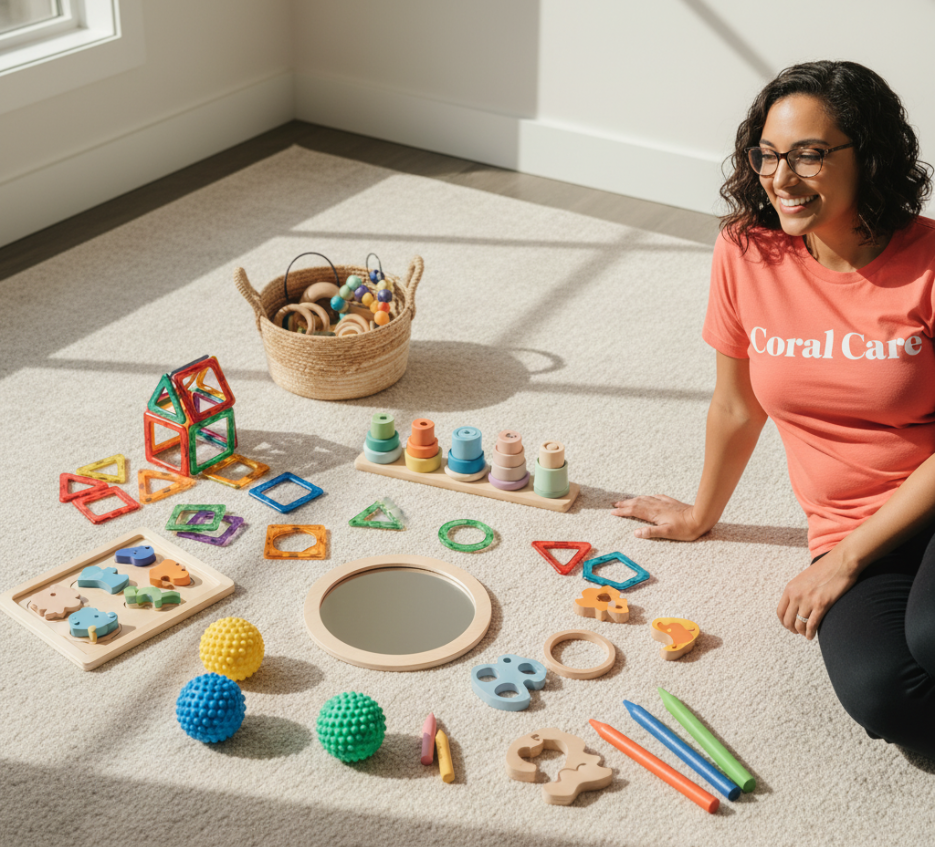
A cozy playroom scene with a Coral Care pediatric therapist sitting on the floor wearing a coral T-shirt and playing alongside open-ended developmental toys. Magnetic tiles, stacking cups, a tummy-time mirror, sensory balls, crayons, and wooden puzzles are arranged on a textured rug, showcasing hands-on, screen-free play for children.

Coral Care content is reviewed and approved by our clinical professionals so you you know you're getting verified advice.

Find effective support for developmental delays, quickly.

Self-pay or insurance
In-person and at-home appointments
No waitlist
Find Care

Concerned about your child's development?

Our free screener offers guidance and connects you with the right providers to support your child's journey.

Take the Screener

Pediatric therapist–approved toys that support real growth through play

Play is the foundation of childhood development. Long before kids learn letters or numbers, they learn by reaching, grasping, stacking, climbing, pretending, building, and exploring. The right toys don't entertain children. They help them grow.

At Coral Care, our pediatric speech, occupational, and physical therapists work with children every day, and we see exactly which toys spark connection, build new skills, and support milestone development at home.

Below is our age-by-age guide to the best developmental toys, chosen by clinicians and rooted in child development science. This list pairs perfectly with our 2025 Pediatric Developmental Gift Guide and our Milestone Guides, which you can explore for deeper support.

Why Developmental Toys Matter More Than “Entertainment Toys”

Not all toys are created equal. Battery-operated, screen-based, or novelty toys often do the work for the child, leaving less opportunity for problem solving, imagination, and real skill-building.

Developmental toys, on the other hand, are:

  • Open-ended (can be used in many ways)
  • Hands-on
  • Sensory-rich
  • Aligned with milestones
  • Endlessly reusable as kids grow

These toys become tools for strengthening coordination, speech and language, motor planning, attention, emotional regulation, and creative thinking.

Best Developmental Toys by Age

Age 0–12 Months: Sensory, Movement, and Early Exploration

Babies learn through movement, repetition, and sensory experiences. The best toys at this age support tummy time, reaching, grasping, early communication, and visual engagement.

Top developmental toys for infants include:

  • High-contrast books and cards
  • Tummy-time mirrors
  • Soft sensory balls
  • Rattles and grasping toys
  • Crinkle and texture books
  • Floor gyms and activity arches

These toys build the foundation for fine motor skills, cause and effect, early strength, and emerging communication.
See the full list in our Infant Gift Guide section.

Age 1 (12–24 Months): Movement, Language Bursts, and Problem Solving

Toddlers learn by doing—climbing, dropping, banging, stacking, and imitating.

Top developmental toys for 1-year-olds include:

  • Stacking cups
  • Push toys and walkers
  • Simple shape sorters
  • Sensory bins
  • Large wooden puzzles
  • Toy kitchens and food sets

These toys support emerging speech, imitation skills, gross motor strength, and cognitive development.

Explore more in our Age 1 Gift Guide section.

Age 2: Big Feelings and Big Milestones

Two-year-olds are explorers full of movement and curiosity.

Best toys for age 2 include:

  • Duplo blocks
  • Climbing structures
  • Simple ride-on toys
  • Pretend-play sets
  • Easy inset puzzles
  • Play tunnels

These toys build emotional regulation, early problem solving, expressive language, and motor planning.

Explore more in our Age 2 Gift Guide section.

Age 3: Imagination and Early Learning

Three-year-olds enter a world of storytelling and pretend play.

Top toys for age 3 include:

  • Dress-up outfits
  • Playsets (farm, dollhouse, fire station)
  • Wooden blocks
  • Art supplies
  • Simple board games
  • Sensory play invitations

These toys support social skills, sequencing, flexible thinking, fine motor control, and early academics.

Explore more in our Age 3 Gift Guide section.

Age 4: Creativity, Collaboration, and Early Problem Solving

Four-year-olds build more complex ideas and love collaborative play.

Best toys for age 4 include:

  • Magnetic tiles
  • Beginner STEM kits
  • Open-ended construction toys
  • Play dough and tools
  • Early board games with rules

These toys strengthen executive functioning, working memory, attention, and early math concepts.

Explore more in our Age 4 Gift Guide section.

Age 5: Independence, Planning, and Skill Expansion

Five-year-olds are ready for deeper creativity and structured play.

Top toys for age 5 include:

  • Advanced magnetic tile sets
  • Craft kits
  • Marble runs
  • Cooperative board games
  • Building sets with steps

These toys support emotional regulation, social reasoning, fine motor precision, and early literacy skills.

Explore more in our Age 5 Gift Guide section.

Ages 6–8: Strategy, Creativity, and Emerging Identity

Children in this range begin to think more abstractly and stay engaged for longer periods.

Best toys for ages 6–8 include:

  • STEM and engineering kits
  • More advanced craft and art tools
  • Strategy-based board games
  • Sports equipment
  • Creative writing or storytelling tools

These toys help strengthen planning skills, perseverance, executive functioning, and social development.

Explore more in our Age 6–8 Gift Guide section.

How to Choose the Right Developmental Toys for Your Child

When selecting toys, look for those that:

  • Invite open-ended play
  • Encourage movement or manipulation
  • Offer sensory richness
  • Support your child's current milestone stage
  • Grow with your child over time
  • Promote connection and shared play

If you're unsure what milestones your child should be working on, explore:

Explore the Full Coral Care 2025 Pediatric Developmental Gift Guide

Whether you're building a playroom, choosing holiday gifts, or supporting a child's developmental needs, our guide offers therapist-approved toys for every age and ability.

👉 Explore the full guide here: https://www.coralcare.com/gift-guide
👉 Explore milestones by age here: https://www.coralcare.com/resources

Because the best gifts don't light up.
They light kids up.

‍

Frequently Asked Questions

What’s the difference between a developmental toy and an entertainment toy?

Developmental toys are open-ended, hands-on, sensory-rich, and aligned with milestones — they invite the child to do the cognitive or physical work. Entertainment toys often do the work for the child: they light up, make sounds, or play on screens. While entertainment toys aren’t inherently harmful, they offer fewer opportunities for real skill-building. The best developmental toys grow with the child and remain useful across multiple stages.

What are the best toys for infants under 12 months?

Babies learn through movement, repetition, and sensory input. The most useful toys at this stage support tummy time, reaching, grasping, and early visual engagement — things like high-contrast books and cards, tummy-time mirrors, soft sensory balls, rattles, and floor gyms. These build the foundation for fine motor skills, cause and effect understanding, and early communication.

When should I introduce building toys like magnetic tiles or STEM kits?

Around age 4, children are ready for magnetic tiles and beginner STEM kits — toys that strengthen executive functioning, working memory, attention, and early math concepts. By ages 5–6, more advanced sets, marble runs, and cooperative board games support deeper problem-solving and planning. These toys remain valuable well into early school age as the child’s capabilities and the play naturally grow more complex.

How do I know if a toy is right for my child’s developmental stage?

The best approach is to look at where your child is developmentally, not just their age. Check what milestones your child is currently working on — our Developmental Milestone Guides break this down age by age. If you’re unsure whether your child is on track or might benefit from extra support, our online developmental screener is a helpful starting point.

Frequently Asked Questions

What developmental toys work best for toddlers 1-3 years?

Shape sorters, stacking rings, simple puzzles, push-and-pull toys, large Duplo blocks, and toy kitchens or tool sets are all high-value for toddlers. This age group benefits from toys that require problem-solving, imitation, and manipulation with both hands. Avoid toys with too many electronic functions — they tend to reduce the child's active participation.

What are the best developmental toys for infants under 12 months?

High-contrast visual cards and mobiles for early visual tracking, textured teethers and rattles for oral and tactile exploration, activity gyms for tummy time and reaching, soft squeeze toys for early grasping, and simple cause-and-effect toys like pop-up boxes. The most valuable "toy" for an infant is consistent, responsive face-to-face interaction with a caregiver.

Related Blogs