
Coral Care content is reviewed and approved by our clinical professionals so you you know you're getting verified advice.

Our free screener offers guidance and connects you with the right providers to support your child's journey.
In-Home Therapy vs. Clinic: What's Actually Different for Kids
Short answer: both settings work, and for young children in-home therapy often leads to faster carryover, because kids practice new skills in the same place they'll use them every day. Clinic therapy offers specialized equipment and a structured space, which can matter for some older kids or specific needs. Most insurance plans cover in-home speech, occupational, and physical therapy the same way they cover clinic visits.
Coral Care is an in-home pediatric therapy provider. Our licensed speech-language pathologists, occupational therapists, and physical therapists come to your home in Connecticut, Illinois, Massachusetts, New Hampshire, New Jersey, Pennsylvania, Rhode Island, Texas, and Virginia. We're in-network with most major plans, and most families start within 1 to 2 weeks.
In-Home vs. Clinic at a Glance
- Where skills are practiced: In-home therapy uses your child's real routines, toys, and spaces. Clinic therapy uses a therapy room that the child visits.
- Carryover: In-home skills transfer to daily life more directly. Clinic skills often need extra practice at home to stick.
- Parent involvement: At home, you're in the room and learn the strategies firsthand. At a clinic, parents often wait outside.
- Equipment: Clinics have larger equipment like swings and gym setups. In-home therapists bring portable tools and use what you already have.
- Scheduling and travel: In-home means no drive, no waiting room, and fewer missed sessions. Clinic visits add travel time to every appointment.
- Insurance: Usually covered the same way for both settings when therapy is medically necessary.
What Clinic-Based Therapy Looks Like
In an outpatient clinic, your child visits a therapy practice on a set schedule. The advantages include access to specialized equipment and a controlled, structured environment. The limitations are real too, particularly for young children: the clinical environment is unfamiliar, skills practiced in a clinic often don't transfer automatically, and weekly appointments add travel and logistics for the whole family.
What In-Home Therapy Looks Like
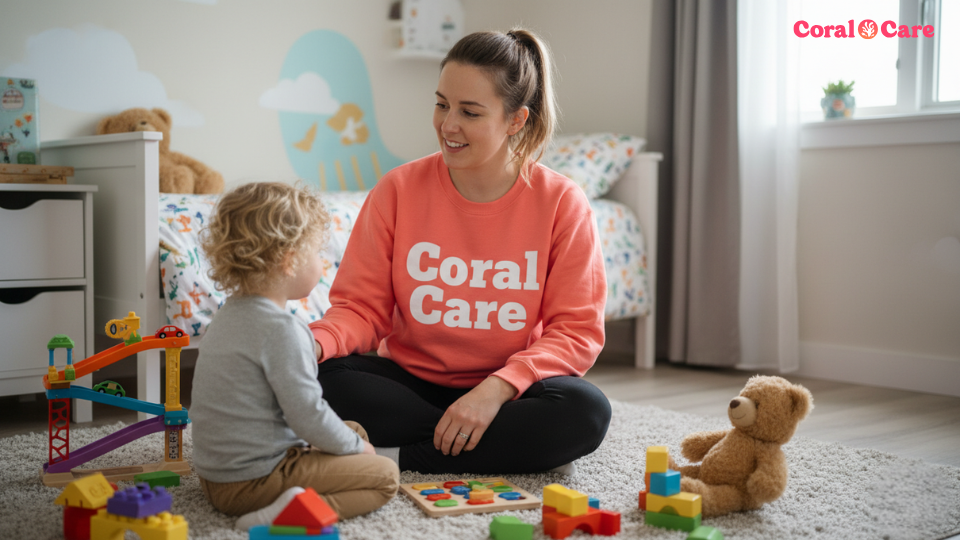
In-home pediatric therapy takes place in your child's natural environment: your living room, your backyard, your child's bedroom and kitchen table. Your therapist comes to you.
This is also how early intervention is designed. Federal law (IDEA Part C) requires early intervention services for children under 3 to be provided, to the maximum extent appropriate, in natural environments, and according to the American Speech-Language-Hearing Association, most children in early intervention receive services in their homes.
Where In-Home Therapy Has a Real Advantage
Generalization happens faster. When skills are learned in the environment where they'll actually be used, generalization is built into the process. A child learning to manage clothing textures practices with their own clothes. A child building physical strength moves through their own home and plays in their own backyard.
Therapists see what's actually happening. When an OT visits your home, they observe your real routines and can recommend specific changes based on what they see, not only what you describe.
Children are more themselves. Young children often shut down in unfamiliar clinical settings. The child a clinic therapist evaluates may behave very differently from the child at home.
Parent involvement is built in. In a clinic, you sit in a waiting room. At home, you're in the room. You can watch techniques, ask questions, and understand what the therapist is doing and why.
When a Clinic Might Be the Better Fit
Some children benefit from clinic-based therapy, for example when therapy calls for large equipment like suspended swings, or when a child does better with a clear separation between "therapy" and home. Your therapist can help you decide, and many families combine settings over time.
Related From Coral Care
Frequently Asked Questions
No referral is needed to start with Coral Care. If your child is under 3, you can also contact your state's early intervention program directly.
Coral Care therapists provide in-home speech, occupational, and physical therapy in Connecticut, Illinois, Massachusetts, New Hampshire, New Jersey, Pennsylvania, Rhode Island, Texas, and Virginia. Find care near you.
Coral Care's self-pay rate is $250 for an initial evaluation and $125 per session. FSA and HSA funds can be used for all services.
In most cases, yes. Most plans cover in-home therapy the same way they cover outpatient clinic therapy. Coral Care verifies your benefits before your first session. Typical in-network copays are $20 to $40 per visit. See insurance and payment details.
Yes. For many children, particularly toddlers and preschoolers, it can be more effective, because skills are practiced in the place they'll be used. The research support for naturalistic, family-centered intervention is strong.