How Occupational Therapy Builds Skills That Show Up in the Classroom and in Life
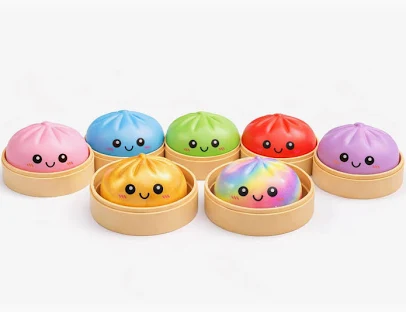
Self-advocacy. Emotional regulation. Generalization. The skills occupational therapy builds don't stay in the therapy room — they show up at school, at home, and everywhere that matters. And the power of squishy dumplings.
author
Jen Wirt, Coral Care CEO & Founder
Coral Care content is reviewed and approved by our clinical professionals so you you know you're getting verified advice.
Find effective support for developmental delays, quickly.
5 min read·Occupational Therapy·Speech-Language Therapy
My daughter came home from school last month with a new skill: persuasive writing.
She wrote a great one for class. A clean, well-argued case for why kids shouldn't have to wear uniforms. Specific examples. Strong conclusion. Her teacher loved it.
Then she brought the skill home.
She had been asking for squishy dumplings for weeks. Little toy dumplings in mystery packaging that may or may not have faces on them. Every kid at recess had one. I had been saying maybe.
So I told her: if you want them, write me the essay. And then present it to me out loud.
She did both.
Her argument, verbatim
"One reason is that I feel really left out. I am always sad at recess. Everybody has one but me."
"Another reason is when I am sad or hurt you can give me a squishy dumpling and I will feel better."
"Lastly, I will listen really well and if I behave bad I will return the squishy dumpling."
"As you can see, she and her sister should get squishy dumplings."
By: S. Wirt, age 9
It made me laugh. It also made me stop and think.
Because what she did wasn't really about writing or presenting. It was a demonstration of skills that took years to build. Skills that most adults are still working on.
Here's what was actually happening beneath the surface of a very sincere argument for a fourteen dollar toy.
What we saw
Six skills. All on display. All real.
01
Self-Advocacy
She named her feelings clearly and specifically. Left out. Sad at recess. She didn't hint at it or hope someone would figure it out. She said it directly, on paper and out loud. That's self-advocacy, and it's harder than it sounds.
02
Perspective Taking
She didn't just argue from her own need. She thought about what I needed to feel okay about yes. The return policy wasn't accidental. She was thinking about my risk, not just her want. That's the ability to understand what another person is thinking and factor it into how you communicate.
03
Expressive Language
Not just in writing. Out loud, organized, in real time, to someone whose answer mattered. That's oral communication under pressure. It shows up everywhere: in friendships, in classrooms, eventually in every room that matters.
04
Emotional Regulation
She had been frustrated for weeks. Instead of escalating, she channeled it into something productive. And when she presented, she held it together even though the stakes were real. Learnable, teachable, and worth building early.
05
Generalization
This is the big one. She took a skill from school and applied it in a completely different context with a completely different audience and completely real stakes. That transfer is genuinely hard. It's often exactly what therapy is working toward.
06
Iteration
The pitch worked. She paid with her own allowance. We drove to the store. Here's the thing about squishy dumplings — they come in mystery packaging. You don't know what's inside until you open it. She opened it. No face. Just a smooth, round, completely expressionless dumpling staring back at her. She kept it anyway.
That's not failure. That's iteration.
She gathered new information, stayed regulated, and went back to the drawing board. That's the skill underneath all the other skills. The ability to keep going when the outcome isn't exactly what you pictured.
The next essay is already coming. I can feel it.
· · ·
These skills don't just appear.
They develop over time, with support, with practice, and for many kids, with the right kind of early intervention.
Occupational therapy and speech-language therapy build exactly these capabilities. Not just fine motor skills or articulation, but the executive function, emotional regulation, expressive language, self-advocacy, and flexible thinking that kids need to navigate the world. The stuff that looks like confidence or maturity from the outside but is actually learnable, teachable, and worth investing in early.
The kids who get that support don't just do better in school. They grow up knowing how to ask for what they need, how to handle it when things don't go their way, and how to take what they learned in one place and use it somewhere new.
That's not a small thing. That's everything.
Wondering if your child could benefit from support?
Coral Care connects families with licensed occupational therapists, speech-language pathologists, and physical therapists across 9 states.
In-home therapy across MA, CT, NH, RI, PA, VA, TX, IL, and NJ
Frequently Asked Questions
What life skills does occupational therapy build?
Pediatric OT supports skills that carry far beyond school: fine motor and handwriting, self-care and independence, attention and regulation, and the motor planning needed to organize everyday tasks. Because these are the building blocks of daily participation, the gains a child makes in OT tend to show up at home, at school, and in the wider routines of life.
How does occupational therapy help kids in the classroom?
Occupational therapy builds the underlying skills that show up across the school day and daily life, from fine motor and handwriting control to attention, regulation, and the ability to organize and complete multi-step tasks. Rather than drilling academic content, an OT strengthens the foundational abilities that make classroom participation and independent functioning possible.
Got it. We'll confirm your exact coverage within 1 business day.
What happens next: our team verifies your benefits, calls or texts you to talk through your child's needs, matches you with a local therapist, and schedules your first home visit. Most families start within about 2 weeks.