

This is some text inside of a div block.

Start with the setup rather than the time limit. Raise the device to eye level, since a tablet flat on a table is the hardest position on a young neck. Let them watch lying on their belly propped on their forearms, which strengthens exactly the muscles that slumping weakens. Add short movement breaks between episodes, heavy work like carrying groceries, and protected outdoor play.

This is some text inside of a div block.

Worth a conversation if your child has neck, shoulder, or back pain, gets headaches after school, cannot sit upright without propping, tires quickly during physical play, avoids climbing and playground equipment, trips or bumps into things frequently, still W-sits past age four or five, or is behind on motor milestones. A physical therapist can evaluate strength, alignment, balance, and movement patterns and build a plan from there.

This is some text inside of a div block.

The American Academy of Pediatrics recommends avoiding screen media other than video chatting before 18 to 24 months, and limiting children ages two to five to about an hour a day of high quality content. The World Health Organization also recommends at least 180 minutes of daily physical activity for toddlers and preschoolers, and at least 60 minutes of moderate to vigorous activity for children five and up.

This is some text inside of a div block.

Mostly by displacement. Skills like balance, catching, climbing, and coordination are built through large numbers of repetitions, and those repetitions only happen during active play. Time spent sitting with a screen is time those repetitions do not happen. Physical therapists often see children who are not delayed in any formal sense but are noticeably less coordinated and less confident with physical challenges than their peers.

This is some text inside of a div block.

Screen time itself is not the cause. Sustained position is. When a child spends hours slumped with the head tipped forward, the muscles adapt to that position, and over time it becomes the posture that feels natural to them. Because children are still growing, that adaptation happens relatively fast. It also reverses relatively fast with strengthening and a better device setup.

This is some text inside of a div block.

Iguana neck is a nickname for forward head posture, where a child's head sits out in front of their shoulders instead of stacked above them. It usually appears alongside rounded shoulders and a slumped upper back, and it is commonly linked to long stretches looking down at phones and tablets. You may also hear it called tech neck or text neck. It is not a diagnosis, but it is a pattern pediatric physical therapists watch for.

This is some text inside of a div block.

No. There is an old superstition about mirrors and babies, but there is no developmental reason to limit mirror play. A mirror is a low-stimulation, self-directed activity, and unlike a screen it responds only to what your baby actually does. Follow your baby's interest. When they stop engaging, move on. The one real limit is supervision rather than duration, since mirror play should happen with you in the room, especially in the first year.

This is some text inside of a div block.

A mirror is a useful tool here, but a strong one-sided preference is worth having looked at. Placing something interesting on the side your baby avoids encourages them to turn that way, and a mirror often holds attention better than a toy. That said, a consistent head tilt, real resistance to turning one direction, or a flat spot developing on one side of the head can point to torticollis, which is common, very treatable, and responds best to physical therapy started early. Mention it to your pediatrician rather than only working on it at home.

This is some text inside of a div block.

It can support it. Speech-language pathologists use mirrors because they make an otherwise invisible process visible. Sounds are produced by the mouth doing things that are hard to see when you are sitting face to face. Sitting side by side at a mirror lets a child watch how mouths actually move, including their own. Keep it low pressure: talk and play normally, let your child see the mouths, and resist the urge to correct. Watching a good model tends to do more than being asked to try again.

This is some text inside of a div block.

A shatterproof floor mirror or a soft fabric tummy time toy with a mirror panel sewn in. Position it at your baby's eye level, roughly eight to twelve inches from their face, which is about where young babies focus best. The point is to give your baby a reason to lift their head, so it needs to sit where they have to work slightly to see it. High-contrast black and white patterns around the mirror can help in the early months, since babies do not see the full color range yet.

This is some text inside of a div block.

Yes, with a few conditions. Use shatterproof acrylic or a mirror sewn into a fabric tummy time toy for any floor play, never glass. Anything larger than a toy should be mounted and anchored to the wall rather than propped against it, because a leaning full-length mirror becomes a tipping hazard as soon as a baby starts pulling to stand. Check regularly for chipped edges, cracks, peeling reflective film, and loose backing, and take damaged mirrors out of the play space. Keep mirror play supervised, and keep mirrors out of the crib and sleep space.

This is some text inside of a div block.

It happens in stages. For the first six months or so, babies love mirrors but are responding to a face rather than to themselves. Between roughly six and twelve months, most treat the reflection like a playmate, patting the glass and looking behind the mirror for the other baby. True self-recognition usually emerges somewhere in the second year, and the clearest signs are physical: watching their own hands move, spotting something behind them and turning to the real object, or noticing something on their own face and reaching for themselves rather than the mirror. There is a lot of normal variation in timing, and a child who is not there yet at twenty months is almost always fine.

This is some text inside of a div block.

Coral Care matches New Jersey families with licensed occupational, speech, and physical therapists who come to your home and work with your child there. It removes the added drive to a clinic and lets sessions happen where your child is most comfortable, on a schedule that fits your family.

This is some text inside of a div block.

Jake's Place in Cherry Hill is nationally recognized for universal accessibility. Central Park of Morris County in Parsippany, Votee Park in Teaneck, Challenger Place in Colts Neck, and Tony's Place in Long Branch all offer inclusive, accessible design with quiet spaces.

This is some text inside of a div block.

Usually not. Most sensory-friendly days and performances welcome any family that benefits. Programs tied to theme park accessibility cards ask for documentation of your child's needs, which you can prepare through your pediatrician or therapist.

This is some text inside of a div block.

Yes. Six Flags Great Adventure in Jackson is a certified autism center with an Attraction Access Program that matches ride criteria to individual abilities. Families set up an IBCCES Accessibility Card in advance. Nearby Sesame Place in Langhorne, PA was the first theme park in the world to earn the certified autism center designation.

This is some text inside of a div block.

Paper Mill Playhouse in Millburn, Mayo Performing Arts Center in Morristown, State Theatre New Jersey in New Brunswick, and the New Jersey Symphony all offer sensory-friendly or relaxed performances with modified lighting and sound, freedom to move, and quiet spaces. Check each venue's calendar for upcoming dates.

This is some text inside of a div block.

Liberty Science Center in Jersey City, Adventure Aquarium in Camden, and Turtle Back Zoo in West Orange all offer strong sensory support, from sensory-friendly days and maps to sensory bags and quiet zones. Turtle Back Zoo and the Prudential Center are certified sensory-inclusive venues. Montclair Art Museum and the Garden State Discovery Museum also run dedicated programs.

This is some text inside of a div block.

Coral Care matches Texas families with licensed occupational, speech, and physical therapists who come to your home and work with your child there. It removes the cross-town clinic drive and lets sessions happen where your child is most comfortable, on a schedule that fits your family.

This is some text inside of a div block.

Usually not. Most sensory-friendly hours and events welcome any family that benefits. Programs tied to theme park accessibility cards may ask for documentation of your child's needs, which you can prepare through your pediatrician or therapist.

This is some text inside of a div block.

Yes. The YMCA's SNAP programs offer adaptive swimming, gymnastics, and dance for children with special needs, including SNAP Aquatics, which teaches swimming and water safety in a non-competitive environment. JumpStreet in Cedar Park also hosts a special needs hour on the first Saturday of the month.

This is some text inside of a div block.

ZACH Theatre and the Paramount Theatre both offer sensory-friendly performances with adjusted lighting and sound and a quiet space. The Long Center provides accessibility features like removable armrests, assisted listening devices, and ASL on request across its resident companies.

This is some text inside of a div block.

Yes. The Wyndham Garden Hotel offers "Thoughtful House" autism-friendly rooms with safety features like door alarms, outlet covers, and corner cushions, plus toys, staff trained in sensitivity, and a special room service menu. Call the hotel and request the package directly, since it is often not bookable online.

This is some text inside of a div block.

Yes. Thinkery, Austin's children's museum, offers Sensory-Friendly Hours about once a month, usually from 8 to 10 a.m., with limited ticket sales, modified galleries to reduce stimuli, a quiet room, and noise-canceling headphones. Siblings are welcome. Check Thinkery's calendar for upcoming dates.

This is some text inside of a div block.

Coral Care matches Texas families with licensed occupational, speech, and physical therapists who come to your home and work with your child there. In a city as spread out as Houston, it removes a long clinic drive and lets sessions happen where your child is most comfortable, on a schedule that fits your family.

This is some text inside of a div block.

We Rock the Spectrum gyms across the area, including Bellaire, Memorial, Sugar Land, Katy, and The Woodlands, offer sensory-safe equipment and calming spaces. For quieter outdoor time, the Houston Arboretum & Nature Center and accessible playgrounds like Donovan Park in the Heights are good options.

This is some text inside of a div block.

Usually not. Most sensory-friendly days and hours welcome any family that benefits. Programs tied to theme park accessibility cards may ask for documentation of your child's needs, which you can prepare through your pediatrician or therapist.

This is some text inside of a div block.

Yes. The Houston Ballet offers autism-friendly performances with trained volunteers, the Hobby Center stages autism-friendly Broadway shows with quiet areas, and Main Street Theater runs sensory-friendly and relaxed performances through its youth program.

This is some text inside of a div block.

Children's Museum Houston runs Sensory Friendly Days several times each school year, with additional dates at the Fort Bend Children's Discovery Center. During these events the museum closes to the public, plays no music, and offers headphones, quiet rooms, and bilingual social stories and visual schedules. Check the museum's website for current dates and registration.

This is some text inside of a div block.

The Houston Museum of Natural Science and Space Center Houston are both certified autism centers, meaning most public-facing staff have autism-specific training and the venues have built reduced-sensory areas and support resources. Both also keep sensory tools available year-round, not just on special event days.

This is some text inside of a div block.

Coral Care matches Texas families with licensed occupational, speech, and physical therapists who come to your home and work with your child there. It removes the drive across the metroplex to a clinic and lets sessions happen where your child is most comfortable, on a schedule that fits your family.

This is some text inside of a div block.

Usually not. Most sensory-friendly days and hours are open to any family that benefits. Programs tied to theme park accessibility cards may ask for documentation of your child's needs, which you can prepare through your pediatrician or therapist.

This is some text inside of a div block.

Yes. The Frontiers of Flight Museum and the Amon Carter Museum both offer free sensory events, and the Kimbell's Studio A sensory play space is free during regular hours. Studio Movie Grill also offers free tickets for children with special needs monthly.

This is some text inside of a div block.

Yes. The Dallas Zoo runs Sensory-Friendly Days with early access before opening, Sensory Havens operated by the TWU occupational therapy department, quiet zones, and a sensory activity tour. Members register in advance, and non-member pricing is modest.

This is some text inside of a div block.

Several, including the Fort Worth Zoo, which was the first zoo in Texas to earn the designation, and Meow Wolf in Grapevine. Certified centers have trained most of their public-facing staff and built quiet spaces, and many keep free sensory bags at guest services.

This is some text inside of a div block.

It is a partnership between the Texas Woman's University School of Occupational Therapy and major Dallas cultural venues that runs coordinated Sensory Days across the city. TWU occupational therapy students help staff sensory rooms and quiet zones at these events. Their calendar is one of the best ways to find sensory-friendly programming in Dallas.

This is some text inside of a div block.

Coral Care matches Massachusetts families with licensed occupational, speech, and physical therapists who come to your home and work with your child there. It removes the drive to a clinic and lets sessions happen where your child is most comfortable, on a schedule that fits your family.

This is some text inside of a div block.

SPED Child and Teen (spedchildmass.com) maintains one of the most complete Massachusetts listings of sensory-friendly events, adaptive recreation, and camps. Checking it at the start of each season is a good way to plan ahead.

This is some text inside of a div block.

The Massachusetts DCR Universal Access Program runs adaptive kayaking, cycling, and other activities across state parks with trained partners and adaptive equipment during the warmer months. Certified sensory-inclusive venues and accessible playgrounds around the state are also good options for calmer outdoor time.

This is some text inside of a div block.

Usually not. Discovery Museum, for example, states that any family who would benefit is welcome and no diagnosis is required. A few programs that involve theme park accessibility cards ask for documentation of your child's needs, which you can prepare through your pediatrician or therapist.

This is some text inside of a div block.

Yes. Discovery Museum's Especially for Me events are free with pre-registration and do not require a medical diagnosis. The Massachusetts DCR Universal Access Program also offers free and low-cost adaptive outdoor activities across state parks, and many library and community sensory storytimes are free.

This is some text inside of a div block.

Boston Children's Museum (Morningstar Access), Discovery Museum in Acton (Especially for Me events), the Museum of Fine Arts (Beyond the Spectrum and MFA Playdates), and the Museum of Science (sensory-friendly Planetarium shows) all run strong programs. The Peabody Essex Museum in Salem is a certified sensory-inclusive venue. Most special events require pre-registration.

This is some text inside of a div block.

Coral Care matches Illinois families with licensed occupational, speech, and physical therapists who come to your home and work with your child there. It removes the stress of driving across the suburbs to a clinic and lets sessions happen in the environment where your child is most comfortable.

This is some text inside of a div block.

For most sensory-friendly hours and events, no. They are open to any family that benefits, and a medical diagnosis is generally not required. A few programs, like a theme park accessibility card for Six Flags Great America, ask for documentation of your child's needs, which you can prepare through your pediatrician or therapist.

This is some text inside of a div block.

The Northern Suburban Special Recreation Association (NSSRA) offers year-round adaptive recreation across member communities and is a go-to for many families. Local events such as Northbrook Days also open early just for people with disabilities, which means smaller crowds and shorter waits.

This is some text inside of a div block.

Several North Suburban park districts offer them. Wilmette Park District has sensory-friendly and quiet swim sessions in summer, and pools like the Northbrook Sports Center host low-sensory evening swims with no music or loud noise. Availability changes seasonally, so check your local park district's schedule.

This is some text inside of a div block.

Yes. Shedd Aquarium is sensory inclusive with a Calm Waters series, free sound-reducing headphones, a quiet room, and a planning app. Lincoln Park Zoo lends sensory bags at the Searle Visitor Center and runs sensory-friendly events, including a lower-stimulation ZooLights night in winter.

This is some text inside of a div block.

Strong options include Kohl Children's Museum in Glenview (Everyone at Play events), Chicago Children's Museum (Play for All early hours and a third-floor calming corner), DuPage Children's Museum in Naperville (adaptive play times), the Griffin Museum of Science and Industry (Low-Sensory Early Exploration mornings), and the Field Museum (a sensory app and free sensory bags). Most require pre-registration for their special events, so check dates ahead of time.

This is some text inside of a div block.

A licensed occupational or speech therapist can help you prepare with regulation strategies, transition supports, and travel-friendly activities tailored to your child. Coral Care connects families with therapists who come to your home, so you can build these skills into your routine before you leave and keep progress steady while you are away.

This is some text inside of a div block.

It is part of the Hidden Disabilities Sunflower program used at many airports. Wearing the lanyard discreetly signals to trained staff that a traveler may need more time or patience, without requiring any explanation. Lanyards are usually free at airport service or information desks.

This is some text inside of a div block.

It is strongly recommended. The IBCCES Accessibility Card takes up to 48 hours to process, and Disney's Disability Access Service requires a live video chat you can start up to 60 days before your visit. Setting these up from home means you can head straight to guest services when you arrive rather than sorting it out at the gate.

This is some text inside of a div block.

Yes. Travelers with non-visible disabilities such as autism can be screened without being separated from their traveling companion. You can inform the officer of your child's needs verbally or with a TSA Notification Card, and you can request a Passenger Support Specialist for hands-on help through the checkpoint.

This is some text inside of a div block.

DPNA stands for Disabled Passenger with Intellectual or Developmental Disability Needing Assistance. It tells airline staff your child may need extra support, such as priority boarding or seating with a caregiver. Add it during booking under special assistance, or call the airline's disability line with your confirmation number and ask them to add it. There is no fee, and it is best to do it at least 48 hours before departure.

This is some text inside of a div block.

Call TSA Cares at 855-787-2227 or submit the online form at least 72 hours before you travel. That gives them time to answer questions about screening and, if needed, arrange for a Passenger Support Specialist to help your family at the checkpoint on the day of your flight.

This is some text inside of a div block.

Passes and sensory-friendly outings support your family's day-to-day life, while occupational, speech, and physical therapy support your child's development over time. Coral Care matches families with licensed therapists who come to your home, so the weekly work happens where your child is most comfortable and without the added stress of getting to a clinic.

This is some text inside of a div block.

Many do. Sensory-friendly events, KultureCity sensory bags, AMC Sensory Friendly Films, and Chuck E. Cheese Sensory Sensitive Sundays are open to any family that benefits, no diagnosis required. Programs that require documentation, like the national parks Access Pass or theme park accessibility cards, will ask for some form of medical or agency documentation, so those are worth discussing with your pediatrician or therapist.

This is some text inside of a div block.

Search the venue name along with "sensory inclusive" or "KultureCity." Certified venues offer free sensory bags with headphones and fidget tools, usually at guest services, and many have a quiet room. Calling ahead is always a good idea to confirm what is available on the day you plan to visit.

This is some text inside of a div block.

They are separate programs. The IBCCES Accessibility Card is used at many parks such as Universal, SeaWorld, and Six Flags, and you register once at accessibilitycard.org. Disney's Disability Access Service is Disney-only, requires a live video chat to register, and is currently intended for guests with a developmental disability who cannot wait in a standard line. Neither one guarantees a specific accommodation on its own.

This is some text inside of a div block.

Most programs accept a range of documents rather than a formal diagnosis code. Common examples include a statement from a licensed physician, an SSI or SSDI letter, VA documentation, or paperwork from a state agency such as an IEP or vocational rehabilitation record. The IBCCES Accessibility Card focuses on the accommodations your child needs rather than the diagnosis itself, so you can redact diagnosis details.

This is some text inside of a div block.

Yes. The America the Beautiful Access Pass is free and lasts a lifetime for U.S. citizens and permanent residents with a permanent disability, and there is no age minimum, so a child qualifies. If you apply in person at a participating federal site, there is no cost at all. Online and mail orders carry a small processing fee. The pass covers the holder and everyone in their vehicle at most parks.

This is some text inside of a div block.

Sometimes. Reading rests on language, so trouble with word retrieval, following directions, or understanding spoken language can show up as a reading struggle. A speech-language pathologist can assess whether language is part of the picture. For some children, a specific reading difference like dyslexia is the driver, which calls for specialized instruction rather than speech therapy.

This is some text inside of a div block.

Both are valid. You can request a school evaluation in writing, and you can also pursue a private occupational or speech evaluation. You do not need a diagnosis or a pediatrician's referral to start a private evaluation.

This is some text inside of a div block.

Usually not. When school is genuinely hard for reasons no one has identified, pulling back is a way of protecting yourself from feeling like a failure. Lost motivation is often a sign that something underneath needs support, not a character flaw.

This is some text inside of a div block.

It is the set of mental skills involved in starting tasks, organizing, planning, managing time, and holding information in mind. When these are weak, even a capable child can struggle to get work done and can start to seem unmotivated.

This is some text inside of a div block.

Indirectly, yes. Occupational therapists work on the foundational skills that schoolwork depends on, such as executive functioning, attention and regulation, and fine-motor and handwriting skills. They do not teach academic content, but they can remove the barriers that make learning the content so hard.

This is some text inside of a div block.

Very commonly. Being bright is not the same as having the underlying skills that make schoolwork doable, like executive functioning, language processing, or handwriting. A capable child can struggle when one of those is lagging, and it often looks like a motivation problem.

This is some text inside of a div block.

If the struggle is in one subject and your child engages when someone works with them, tutoring may be enough. If they are struggling across subjects, working hard without progress, or losing motivation, it is worth checking for an underlying skill before adding more tutoring hours.

This is some text inside of a div block.

Coral Care's developmental guides lay out what most children are doing at each age, from 0 to 18 years. They are an easy way to see where your child is and bring specifics to your pediatrician.

This is some text inside of a div block.

No. Early support can begin based on need. You do not have to wait for a formal label, or even a referral, to ask for an evaluation.

This is some text inside of a div block.

The update was meant to move away from waiting, even though some ages moved later. If your instinct or the checklist says something is off, it is worth raising now.

This is some text inside of a div block.

Because babies vary widely in whether and when they crawl, so it was not a reliable single marker. That said, many physical therapists still consider crawling developmentally valuable, so mention it to your pediatrician if your child skips it along with other concerns.

This is some text inside of a div block.

Not necessarily. A missed milestone is a reason to ask, not to panic. The point is to look, not to label.

This is some text inside of a div block.

It is a real concern that therapists raised. The safeguard is to treat the listed age as the point where a delay is obvious, not a deadline to wait for, and to act on any concern earlier. You never have to wait for the checklist age to ask for an evaluation.

This is some text inside of a div block.

For some skills, yes. Walking is not flagged until 18 months and a first word shifted to 15 months, among others. That is why many therapists worried the change could delay help for some children.

This is some text inside of a div block.

They were updated so each milestone reflects what most children, about 75%, can do by a given age, with new checkpoints and a clearer "act early" message, aimed at making a missed milestone a more obvious signal.

This is some text inside of a div block.

Start with a feeding therapist (a speech-language pathologist or occupational therapist) for the functional feeding assessment, with a lactation consultant for breastfeeding support and your pediatrician involved. Add an experienced ENT or dentist if a procedure is being considered.

This is some text inside of a div block.

Awareness has grown, which helps some babies, but the threshold for diagnosis has also loosened, and many providers worry some releases happen without a full evaluation.

This is some text inside of a div block.

Feeding support usually comes first, and when a release is done, pairing it with feeding therapy before and after tends to give the best results.

This is some text inside of a div block.

It is a tie diagnosed deeper under the tongue and less visibly. It is the most debated type, so a diagnosis there is worth a careful second look.

This is some text inside of a div block.

For most children the speech impact is smaller than online claims suggest. A speech-language pathologist can assess directly if you are concerned.

This is some text inside of a div block.

A speech-language pathologist or occupational therapist with infant feeding training can perform the functional feeding evaluation, watching a full feed and assessing how the tongue and mouth are working. A lactation consultant adds breastfeeding-specific support, and the two work well together. You do not have to start with a lactation consultant.

This is some text inside of a div block.

No. Real ties can benefit from a release, but many feeding struggles improve with positioning and latch support first. A full feeding assessment should come before any procedure.

This is some text inside of a div block.

It is when the tissue under the tongue is short or tight enough to limit movement. Some are significant, some are minor, and not all affect feeding.

This is some text inside of a div block.

If meltdowns, trouble settling, or difficulty engaging in play show up across the whole day and not just at screen-off time, it is worth talking to your pediatrician or an occupational therapist.

This is some text inside of a div block.

It can help. Slower shows with real faces, songs, and pauses are gentler on attention and better at modeling language.

This is some text inside of a div block.

General guidance favors limited, co-viewed screen time for young children. Quality and company matter more than hitting an exact number, and your pediatrician can help you find a fit for your family.

This is some text inside of a div block.

Its rapid cuts and constant novelty are very stimulating, which is why kids lock in. For some children, slower-paced shows are an easier fit, especially close to nap or bedtime.

This is some text inside of a div block.

Because the show is far more stimulating than what comes next, and toddlers are still learning to handle transitions and big feelings. It is normal, and it gets easier with warnings and routine.

This is some text inside of a div block.

No. There is no evidence that a cartoon causes autism or ADHD. These are neurodevelopmental differences, not the result of a show.

This is some text inside of a div block.

Not in small, intentional doses. The real concerns are its fast pace and the way heavy viewing can crowd out talk and play, not any single dangerous effect. How you use it matters more than whether you use it.

This is some text inside of a div block.

Yes. A licensed speech-language pathologist comes to you and works in your everyday spaces, then teaches you how to support your child's language between visits.

This is some text inside of a div block.

An SLP figures out why your child is communicating the way they are, responds to your child in the moment, and coaches you on what to do between sessions. A video cannot assess your child or adjust to them.

This is some text inside of a div block.

Not necessarily, but it is worth a closer look. If your child is not using words by 15 to 18 months or combining words by around 24 months, ask your pediatrician or a speech-language pathologist.

This is some text inside of a div block.

General guidance favors very limited screen media for children under about 18 months, apart from video chatting, and watching together once you introduce it. Your pediatrician can help you decide what fits your family.

This is some text inside of a div block.

Passive, solo screen time does little for language and can crowd out interaction. Watching with your child and talking back makes the same screen time far more useful. The company matters more than the screen.

This is some text inside of a div block.

Because she uses real language strategies: slow speech, heavy repetition, gestures, songs, and expectant pauses. Children also tend to gain words right when they are developmentally ready, and many parents start interacting more after watching her, which adds up.

This is some text inside of a div block.

Screens can model language, but children learn to talk through back-and-forth interaction with responsive people. Shows like Ms. Rachel can support language when you watch together and turn it into a two-way activity, but they do not replace real conversation.

This is some text inside of a div block.

With Coral Care, you do not need a referral to get started. Our licensed therapists come to you, in person, and sessions are covered by most commercial insurance plans. You can book an evaluation any time to get matched with a provider and begin.

This is some text inside of a div block.

Every child grows on their own timeline, so milestones are a guide, not a scorecard. The Well-Visit Planner includes a milestone reference by age, from birth to 12, drawn from Coral Care's developmental guides and reviewed by our licensed pediatric therapists. If you are not sure where your child stands, you can book an evaluation with one of our licensed pediatric therapists, who will get to know your child and talk through what you are seeing.

This is some text inside of a div block.

A few worth raising: How is my child tracking for their age? Are there milestones I should watch for before the next visit? If my child could use extra support, what are our options and how soon could we start? Would speech therapy, occupational therapy, or physical therapy help? The Well-Visit Planner lists these so you can circle the ones that matter to you.

Speech-Language Pathology
/
August 5, 2026

Best practices for speech therapy for toddlers

Looking for speech therapy for toddlers and kids? Learn on how tailored strategies can help kindergartners enhance their communication skills and confidence!

author
Fiona Affronti
Fiona Affronti
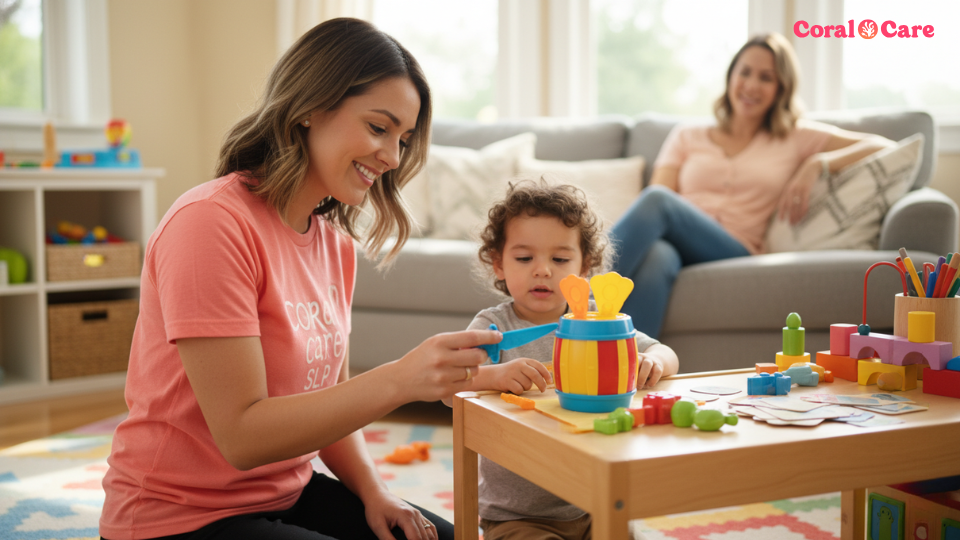
A child and a speech therapist share a table, focused on a toy, highlighting their interaction and playfulness

Coral Care content is reviewed and approved by our clinical professionals so you you know you're getting verified advice.

Find effective support for developmental delays, quickly.

Self-pay or insurance
In-person and at-home appointments
No waitlist
Find Care

Concerned about your child's development?

Our free screener offers guidance and connects you with the right providers to support your child's journey.

Take the Screener

Worried that your toddler isn’t speaking as expected? This guide covers everything you need to know about speech therapy for toddlers, including how to identify if your child could benefit from therapy, common speech and language challenges, and what to expect during sessions.

Key takeaways

  • Speech therapy for toddlers aims to improve communication skills and address developmental delays through engaging methods provided by licensed speech-language pathologists.
  • Recognizing signs of speech disorders, such as stuttering or articulation difficulties, is crucial for early intervention, as timely evaluation can lead to better outcomes.
  • You can get care for your child in two weeks or less, with no waitlist, through Coral Care. 
  • Parental involvement is essential in speech therapy, with consistent home practice and supportive environments significantly enhancing a child’s progress and language development.

What is speech and language therapy for toddlers?

A speech therapist engages in conversation with a young boy, sharing a moment of connection and communication.

Speech-language therapy is a specialized treatment designed to help individuals with speech and language disorders. For smaller children, like toddlers, speech therapy aims to help them communicate effectively, which may involve tackling challenges that might hinder their verbal and non-verbal expression, including body language (National Library of Medicine).

The goals of speech therapy for toddlers are multifaceted. The goal is to improve communication skills, address delays, and ensure developmental milestones are achieved. Different types of speech and language challenges, including difficulties with understanding and/or forming words, are addressed during therapy. By focusing on both receptive and expressive language skills, speech therapy enhances a child’s overall communication abilities.

Licensed speech-language pathologists typically provide speech therapy for toddlers (American Speech-Language Hearing Association). These professionals use engaging tools like games and books to make learning enjoyable and effective. Improvement in a child’s communication can lead to better interactions and higher self-esteem, making speech language pathology a valuable service for any toddler facing communication challenges.

Common speech and language challenges in toddlers

A woman and a young girl are seated on the floor, sharing a moment of connection and warmth together

A speech disorder refers to a difficulty with making sounds, which can manifest in various forms among toddlers. One of the more recognizable types of speech disorders is stuttering, where a child struggles to produce smooth sentences. This condition can significantly impact a child’s ability to communicate effectively, resulting in frustration and social withdrawal. Articulation difficulties are another common issue, where toddlers may have trouble pronouncing words correctly. This can include phonological process disorders, characterized by patterns of sound mistakes, making it challenging for others to understand the child’s speech. These articulation disorders often require targeted interventions to help the child improve their speech intelligibility (Cleveland Clinic). 

In addition to speech issues, many toddlers experience challenges with language development. These can affect both expressive language, or the ability to use words and sentences to communicate, and receptive language, which is the understanding of what others are saying. Toddlers with expressive language challenges might use fewer words than their peers or use gestures instead of words to communicate, while those with receptive language difficulties may have trouble following directions or understanding simple questions.

Challenges with social communication can also arise in early childhood. A toddler with social communication difficulties may find it hard to engage in simple back-and-forth interactions or may not use typical gestures like waving or pointing. Parents might notice that their child seems less responsive to social cues, which can affect play and early friendships.

Finally, some toddlers may struggle with play skills, which are essential for vocabulary expansion and more complex language use as they grow. Symbolic play—such as pretending to feed a doll or talking on a toy phone—helps build language and cognitive skills. When a toddler shows little interest in pretend play or doesn’t engage in imaginative scenarios, it can be a sign they need additional support to help their language skills develop alongside their play abilities.

Recognizing signs your toddler may need speech therapy

Recognizing the signs that your toddler may need speech therapy is crucial for early intervention. Missing key speech and language developmental milestones can be a significant indicator. By age four, children should be able to communicate beyond single-word sentences; so difficulties in this area should prompt evaluation (Children’s Hospital of Orange County). If your child is using only one-word sentences beyond the expected developmental stage, it might indicate an expressive language disorder that needs assessment. It is important to remember that milestones are important, but they are also approximations - being a few weeks or months behind is not necessarily a reason for concern.

Listening and understanding language are also essential parts of communication. If a toddler frequently has difficulty understanding or following simple instructions, such as “put your toy in the box”, it could suggest a receptive language delay. Likewise, if your child doesn’t seem to understand basic questions or respond to common phrases, this can be another indicator that assessment may be beneficial.

Pronunciation difficulties, such as trouble pronouncing particular letters or words, and delayed first words, are also red flags. For instance, if a child consistently leaves out syllables in words, it could signal a phonological process disorder affecting their pronunciation skills (BabyCenter.com). Additionally, selective mutism, where a child refuses to speak in certain situations, may require specialized treatment from a speech-language pathologist. A speech delay may also be a concern (National Health Services).

Stuttering is another sign to watch for. Children who stutter might exhibit unusual facial expressions or discomfort when speaking. If stuttering persists after age five, it warrants a professional evaluation. Early detection and intervention are key to addressing these issues effectively. All children learn and grow in their own ways, so it is important to get your child the help they need to thrive.

Developmental milestones for toddlers

A woman and a child lovingly pet a rabbit, capturing a heartwarming moment of companionship and joy

Understanding the developmental milestones for toddlers is essential in identifying potential speech and language delays. By 18 months, a child should know around 20 words (Raising Children Network). By age 2, they typically start combining at least two words to form simple sentences. These early speech and language milestones are crucial indicators of a child’s language development (Stanford Medicine Children’s Health).

As toddlers grow, their vocabulary and communication skills expand rapidly. By around 30 months, they usually have a vocabulary of over 50 words and can follow two-step instructions. By age 3, most toddlers know more than 200 words and can engage in short conversations, asking questions starting with who, what, where, or why. These milestones reflect a child’s cognitive and language development (Stanford Medicine Children’s Health).

Providing a rich language environment, such as labeling objects even if the child is not yet speaking, prepares them for future language use. Early verbal interactions play a significant role in a child’s ability to meet these developmental milestones and should be encouraged consistently. Talk to your child about anything you do together, as the introduction to words and speech patterns are paramount for development. Plus, it’s a great way to grow the bond between you and your child. 

Finding a qualified speech language pathologist

Finding a qualified speech-language pathologist, also known as SLP, is a crucial step in ensuring effective speech therapy for your toddler. An SLP must have at least a master’s degree and relevant state licensure to practice (Speech And Hearing, California Government). Additionally, they should be experienced in pediatric care and Many providers/private clinics screen SLPs before hiring, which helps take the pressure of screening SLPs off your shoulders. Specifically, at Coral Care the average practitioner at Coral Care has 13+ years of experience in their specialty and is rigorously vetted prior to hire. If you want guaranteed quality care, Coral Care is the perfect place to start.

When it comes to locating a speech-language therapist, there are an overwhelming amount of options. We recommend you start by consulting local directories, seeking referrals from doctors or teachers, looking through Coral Care’s website, and exploring resources on the American Speech-Language-Hearing Association ASHA website. In addition, it can be helpful to contact your pediatrician, ask for recommendations from friends, check your health insurance plan, and read online reviews. These steps can help you find a qualified professional who meets your child’s needs, as well as your values, through pediatric speech therapy.

During a preliminary appointment or the first visit it is essential to ensure the therapist connects well with your child and possesses the necessary experience and licensure. A good fit between the therapist and child can significantly enhance the effectiveness of the therapy sessions and contribute to better outcomes.

What to expect during speech therapy sessions

Speech therapy sessions use various activities to aid in communication development. These may include games, songs, and storytelling, which are designed to promote natural language development in a fun and engaging manner. Play-based learning is a core component of these sessions, making them enjoyable for toddlers (Therapy Connect).

Therapy sessions usually take place once or twice weekly. Each session typically lasts from 30 to 60 minutes. The first session usually focuses on getting to know each other, making the child comfortable, observing the child, and discussing goals. Therapists try to make sure the environment is stimulating, in order to keep the child engaged and motivated. 

Coral Care takes comfort in a therapy environment to the next level, because providers come directly to your house for in-home care. Your child feels comfortable because they are in their familiar and safe space, and you don’t have to sit in traffic, coordinate rides, or take time off work. Coral Care is dedicated to ensuring that getting care for your child is not a hassle or a burden, but instead, a fantastic opportunity for you to set your child up for success. You can schedule your in-take appointment right now, by clicking here.

Parents are highly encouraged to participate in these sessions. Active collaboration between parents and speech therapists enhances the effectiveness of therapy, as parents provide unique insights into their child’s motivations and frustrations. This partnership is crucial for monitoring the child’s development and making necessary adjustments to therapy methods. 

Parental involvement after speech therapy

A woman stands beside a crib, holding a baby, embodying warmth and nurturing in a serene setting

Parents play a pivotal role in the success of their child’s speech therapy. Their participation can significantly enhance the child’s progress. Consistent practice at home is crucial for maintaining progress and should take about 10 to 30 minutes daily. Speech therapists provide strategies and resources to support effective home practice, ensuring that parents are well-equipped to help their child.

Family members should exhibit patience and understanding as the child learns and develops speech skills. Encouraging and supportive environments foster better outcomes in speech therapy. Integrating therapists’ strategies into daily routines helps parents reinforce what their child learns during therapy, making the process more effective.

Benefits of early intervention in speech therapy

A speech therapist and children gathered around a table, engaging with a doll, showcasing a moment of joy and togetherness

Now that you understand what speech therapy for your toddler is, it is important to understand just how important speech therapy is for a child. Early intervention is crucial for toddlers requiring speech therapy. It helps them reach communication goals by addressing delays as soon as they are identified. Starting speech therapy early ensures toddlers develop essential communication skills, leading to better outcomes. Early intervention can also prevent more severe communication issues from developing (Napa Center).

In addition, speech therapy improves various aspects of a toddler’s communication, including speech, language skills, and social interactions. It also aids cognitive development through play and daily routines (Cleveland Clinic). When parents and therapists align their efforts, it creates a supportive environment that benefits the child. Empowering parents with the right strategies enhances their ability to facilitate speech improvement effectively.

How long will my toddler need speech therapy?

The duration of speech therapy for a toddler depends on factors like the severity of the speech challenge. More severe conditions may require extended treatment, while milder issues might be resolved more quickly (Riverbend Pediatric Therapy).

The type of communication disorder also influences the length of therapy. Each child receives a tailored plan based on their specific challenges, and progress is monitored closely to make necessary adjustments. Regular evaluations track the child’s development and help determine the appropriate therapy duration (Riverbend Pediatric Therapy).

Parents should remember that speech therapy is a gradual process, focusing on consistent progress rather than a fixed timeline. With the right support and intervention, most children show significant improvements in their speech and language abilities over time. While there is no specific timeline, there is the ability to focus and celebrate the small victories your toddler makes every day.

Tips for enhancing language skills at home

Enhancing language skills at home is a crucial part of supporting your child’s speech therapy progress. Regular engagements and conversations between parents and children play a significant role in language development (Mrs. Meyer’s Learning Lab). Offering labeled praise, specific to the child’s actions or words, can motivate them to communicate more effectively.

Parents can foster communication by strategically placing items out of reach, prompting children to ask for them. Engaging in symbolic play, like pretending a banana is a phone, helps toddlers connect language with imaginative thought, aiding in language acquisition. Creating disruptions in familiar routines can encourage children to notice and communicate about changes, enhancing their language skills (Healthline).

Avoid negative corrections (“don’t do…”) and instead use positive phrasing (“please do…”)  to foster a supportive environment for language exploration. These practical tips can make a significant difference in a child’s language development and complement the efforts made during speech therapy sessions.

Drawn-out

Recognizing the signs that indicate a need for speech therapy for your toddler, as well as understanding developmental milestones and finding a qualified speech language pathologist, are crucial steps in this journey. Speech therapy sessions, combined with consistent home practice and positive reinforcement, can significantly enhance a child’s communication skills.

By taking proactive steps and staying engaged in your child’s speech development, you can help them overcome challenges and reach their full potential. Early intervention not only improves speech and language abilities but also boosts a child’s confidence and social interactions. Embrace this journey with patience and dedication, knowing that your efforts will make a lasting impact on your child’s life.

Coral Care is the most effective, and easiest, way to get your child help if you live in MA, RI, NH, or Texas. No long waitlists, or drawn out processes, just care for your child. Start your journey with Coral Care today by taking a free screener here, or scheduling an appointment now.

Frequently Asked Questions

How do I find a qualified speech-language pathologist?

To find a qualified speech-language pathologist, find SLPs in your area on Coral Care, consult local directories, obtain referrals from healthcare professionals, or utilize resources on the ASHA website.

What can I do at home to support my child’s speech therapy?

To effectively support your child's speech therapy at home, engage in regular conversations and encourage them to communicate during play. This approach enables your child to practice their speech skills in a natural and supportive environment.

How long will my child need speech therapy?

The length of speech therapy for your child will depend on the severity and type of speech disorder, along with any accompanying conditions. Regular evaluations will help determine progress and adjust the therapy plan accordingly.

What types of activities are used in speech therapy sessions for toddlers?

Speech therapy sessions for toddlers commonly incorporate games, songs, and storytelling to facilitate engaging learning experiences. The use of play-based activities is essential, and active participation from parents is strongly encouraged.

How can I tell if my toddler needs speech therapy?

If your toddler is missing developmental milestones, has a limited vocabulary, struggles with pronunciation, or is using one-word sentences beyond the expected age, it may indicate a need for speech therapy. Consulting a speech-language pathologist can provide guidance and support.

Related Blogs