
Coral Care content is reviewed and approved by our clinical professionals so you you know you're getting verified advice.

Our free screener offers guidance and connects you with the right providers to support your child's journey.
Most parents sign their kid up for tennis for pretty simple reasons. A friend plays. The clinic at the town courts had an open spot. It gets everyone outside on a Saturday morning.
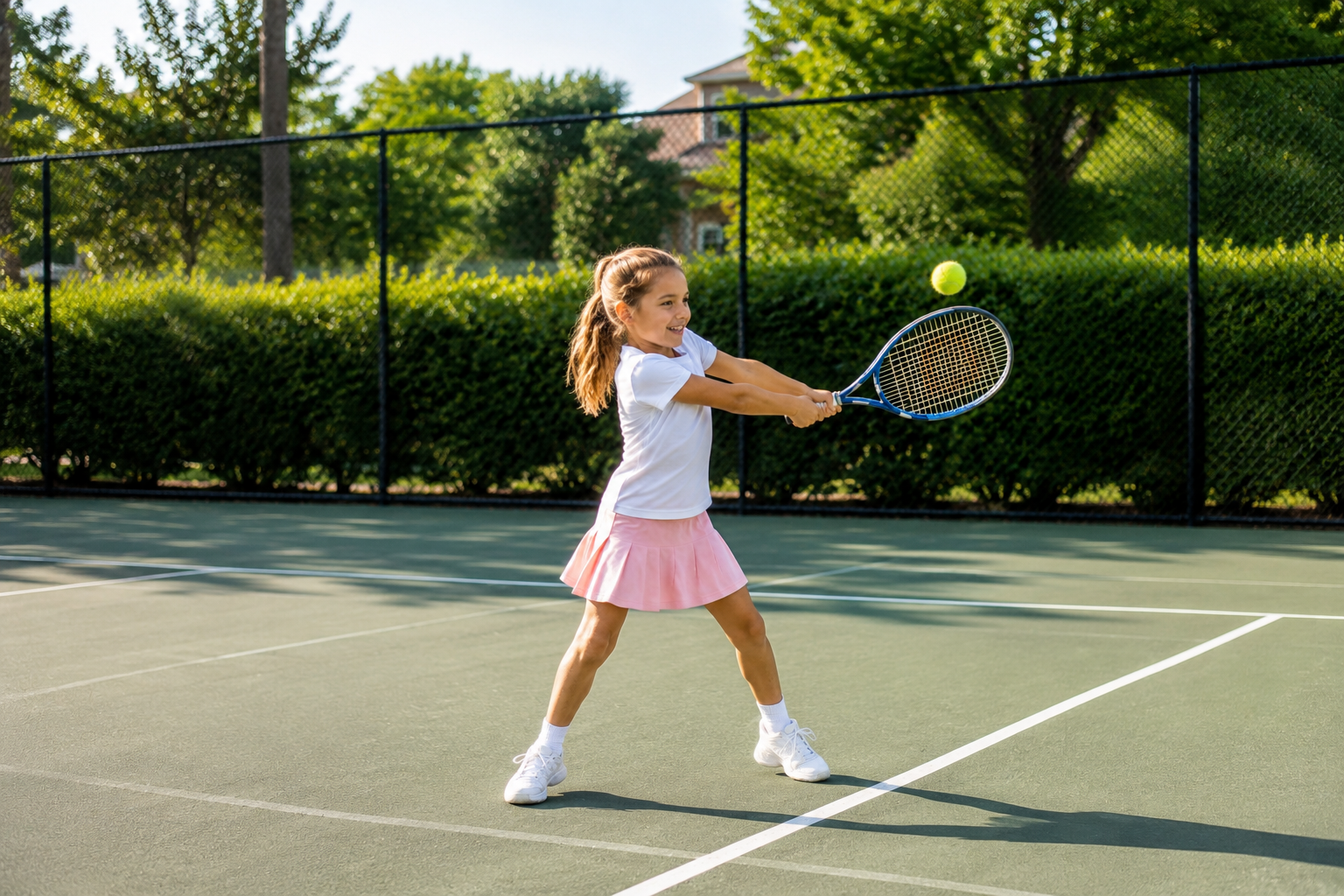
Then you watch a seven year old try to hit a moving ball with a stick while standing on one foot, and you start to realize how much is going on under the hood. Tennis asks a child to do several hard things at the same time, and that combination is what makes it such a rich sport for a growing body and brain.
Key takeaways
- Tennis trains cross body coordination, visual tracking, and dynamic balance all at once, which is a rarer combination than most youth sports offer.
- Scaled equipment matters more than anything else. The red, orange, and green ball stages use softer balls, shorter racquets, and smaller courts so kids can actually rally.
- Looking awkward as a beginner is normal. A pattern of difficulty that also shows up in everyday movement is worth a closer look with a pediatric occupational or physical therapist.
What tennis asks of the body
Both sides of the body have to cooperate. A forehand starts in the legs, travels through a rotating trunk, and finishes in the arm. That kind of cross body movement, where one side of the body works with the other across the middle, is a foundational motor skill. It shows up later in handwriting, in cutting with scissors, in getting dressed. Racquet sports are one of the more fun ways to practice it.
The eyes and hands have to work as a team. Hitting a ball that is already moving on an unpredictable path is a much harder visual task than kicking a stationary ball or throwing at a fixed target. Your child has to track the ball, predict where it will be in half a second, and get a racquet to that spot. This is visual motor integration, and it is closely tied to school readiness skills like copying from a board and keeping place on a page.
Balance is constantly being challenged. Split steps, sprints to the net, changes of direction, hitting while slightly off balance. Tennis trains the kind of dynamic balance and postural control that a straight line sport like running does not.
Bones get loaded from every angle. The multidirectional impact of tennis is good for bone density and agility in a way that is different from swimming or cycling.
What tennis asks of the brain
Every single point requires a fast decision under time pressure. Read the ball, choose a shot, adjust mid swing when the bounce surprises you. Researchers who study racquet sports and executive function tend to focus on two skills in particular: inhibition, which is the ability to stop a movement you already started, and cognitive flexibility, which is the ability to switch plans quickly. Tennis drills both, hundreds of times an hour.
There is a quieter benefit too. Tennis scoring is strange. Love, fifteen, thirty, forty, deuce, ad in, ad out. For a young child, keeping score is real working memory and numeracy practice, and they have to do it while breathing hard.
What tennis asks of a kid emotionally
This is the part parents are usually least prepared for.
In tennis there is nowhere to hide. No teammate takes the next shot for you. Every mistake is visible and belongs to your child alone. For some kids that is exactly the confidence builder they needed. For others it is hard, especially early on, and it is worth knowing that going in.
Two things about tennis help with this.
Kids officiate themselves. In junior tennis, players call their own lines. That means honesty, negotiation, and conflict resolution with no adult in the middle. It is one of the few youth sports settings where children have to resolve a disagreement on their own.
The reset is built into the game. There are roughly twenty seconds between points. Over a season, kids get hundreds of reps at the skill of feeling frustrated, letting it go, and starting the next thing. That transfers well outside the court.
Getting the setup right matters more than anything
If there is one thing to take away from this post, it is that the equipment and court size have to match your child.
Junior tennis uses a color coded progression. Red ball for the youngest players, then orange, then green, then the standard yellow ball. Each stage uses a softer, slower ball, a shorter racquet, and a smaller court. This is not a watered down version of tennis. It is the version where a five year old can actually rally, feel successful, and build real mechanics.
Putting a young child on a full size court with a standard yellow ball usually produces two things: bad technique and a kid who quits. If a program you are considering does not use scaled equipment, ask why.
It is also worth knowing that tennis has a steeper early learning curve than soccer or basketball. The first couple of months can feel discouraging. That is normal and not a signal about your child and athletics.
A few things to keep an eye on
Tennis is a one sided sport. All that rotation happens in the same direction with the same arm. A second sport, or general strength and mobility work, helps balance it out.
Early specialization carries real risk. The overuse injury and burnout data on single sport youth athletes is consistent enough that most sports medicine groups recommend playing multiple sports through at least middle school. Let tennis be one of several things.
Struggle is normal. A pattern is worth a conversation. Every beginner misses. But if your child is consistently losing balance during ordinary movement, avoiding activities that require both hands together, having trouble tracking a slow moving ball at close range, or getting noticeably more tired than peers doing the same drills, that is useful information rather than a reason to panic. A pediatric physical therapist or occupational therapist can look at the underlying motor skills and tell you whether anything needs support. Often the answer is that your child just needs more practice reps, and it is good to know that for certain.
The honest summary
The strongest evidence for tennis sits in visual motor skill, coordination, and executive function. Those are real and well documented. The character building part is harder to measure, but if you have watched a nine year old lose a close match, shake hands anyway, and ask when the next one is, you have seen something worth keeping.
Sign your kid up. Get the right size ball. Let them be bad at it for a while.
Wondering whether your child is on track?
Coral Care connects families with licensed pediatric occupational therapists, physical therapists, and speech-language pathologists who come to you, in person, on your schedule. We work with commercial insurance and see kids from birth through age 18. Get started or see how coverage works.
Frequently Asked Questions
Often yes, and it can be a good fit because the ball speed and court size are adjustable. It helps to talk with a coach ahead of time about pacing, and to start with red ball equipment regardless of age. If your child already works with a pediatric occupational therapist or physical therapist, that provider can suggest specific adjustments.
Team sports do more for cooperation, shared strategy, and group belonging. Tennis does more for individual accountability, self regulation, and visual motor precision. Neither is better. Many kids benefit from having one of each.
Most sports medicine guidance says no, at least not before the mid teens. Playing multiple sports lowers injury risk, reduces burnout, and builds a broader movement base. Kids who specialize later do not appear to be at a disadvantage.
Not on its own. Hitting a moving ball is one of the harder motor tasks we ask kids to do, and most beginners look awkward for months. What is worth paying attention to is whether the same difficulty shows up in everyday movement, like frequent tripping, trouble with buttons and scissors, or avoiding playground equipment. If you are seeing a pattern across settings, a pediatric occupational therapist or physical therapist can help you understand what is going on.
Played with scaled equipment and mixed with other activities, tennis is generally low risk and good for developing bones. The concerns come from volume and repetition, not from the sport itself. Year round single sport play with a full size racquet is where overuse problems tend to show up.
Around four or five works well with red ball equipment, which uses a soft, slow ball on a small court. Before that, most kids get more out of general movement play. There is no advantage to starting formal lessons early, and plenty of strong junior players did not pick up a racquet until eight or nine.