
Coral Care content is reviewed and approved by our clinical professionals so you you know you're getting verified advice.
Find effective support for developmental delays, quickly.

Concerned about your child's development?
Our free screener offers guidance and connects you with the right providers to support your child's journey.
Squishies are everywhere right now, and that's not a bad thing. Behind the viral hype, these toys give kids real sensory input, a way to calm down, and a workout for their hands.
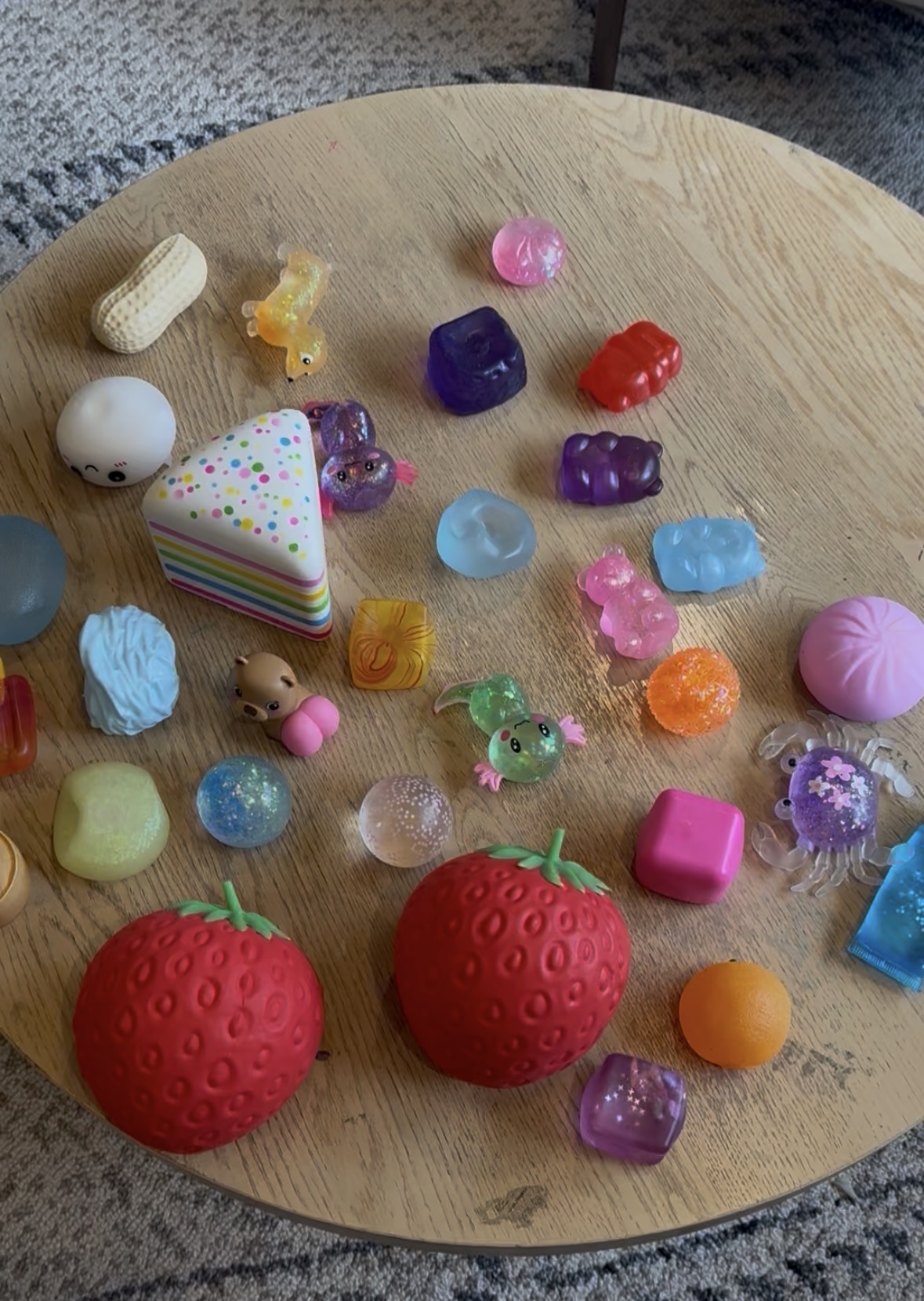
If you have school-age kids, you probably have a drawer (or a bedroom) full of them. Squishy dumplings, croissants, strawberries, stretchy NeeDohs, textured balls with stringy bits. Kids collect them, trade them at school and camp, and know exactly who has the rare ones.
Our CEO and Founder, Jen Wirt, has two girls, ages 8 and almost 10, and a house full of squishies. "I know it's a complete viral mania, but I don't hate it," she says. "At the end of the day, they're fun stress balls."
Here's what occupational therapists want parents to know about why kids love squishies, what they do for development, and how to keep them safe.
Why kids can't stop squeezing
Squeezing feels good for a reason. It gives the body deep pressure input, which is naturally calming for the nervous system.
- Deep pressure: A firm squeeze sends calming signals to the brain, the same way a tight hug or a weighted blanket can.
- Cause and effect: You press, it changes shape, it slowly comes back. That predictability is satisfying, especially when the rest of a kid's day feels unpredictable.
- Collecting: Kids have always collected things. "My generation went wild for Beanie Babies, convinced the right one, perfectly preserved, would make us rich," Jen says. "Collecting something that also helps kids self-soothe is honestly a dream."
Squishies are sensory tools
Yes, squishies count as sensory toys. They give kids two kinds of input occupational therapists work with every day.
- Tactile input: Touch and texture. Smooth, sticky, bumpy, stringy.
- Proprioceptive input: The pressure kids feel in their muscles and joints when they squeeze, pull, and knead.
That makes squishies useful for many kinds of kids:
- Sensory seekers get a safe, portable outlet for input they crave.
- Texture-cautious kids can explore new textures at their own pace, with no pressure.
- Kids who need to move to focus can keep their hands busy while their body stays put.
Jen's girls each gravitate toward different sensations. "The NeeDoh has a lot of tension, so it's a favorite for heavy squeezing," she says. "They also love the textured ones with stringy bits that feel nice running through your fingers."
Help with calm and focus
Squeezing something gives kids a physical outlet for a big feeling and a moment to pause before reacting. That makes squishies a helpful tool for stress, frustration, and anxious moments.
- After a hard day: "My girls will pull out their whole collection, line them up, sort them into categories, and quietly play," Jen says. "That calm, repetitive play is incredibly regulating and helps them recenter."
- During homework: A squishy gives busy hands something to do so the brain can focus. Jen's younger daughter usually keeps one next to her while she works.
- On long car rides: Both girls bring two or three for the trip.
The key is helping kids learn to reach for a squishy when they notice they're getting worked up. That turns it into a real coping strategy, not just a distraction.
Stronger hands, better fine motor skills
Every squeeze is a small workout. Squishy play builds the hand strength and coordination kids need for everyday tasks.
- Squeezing builds grip strength.
- Pinching works the small muscles of the fingers.
- Pulling and kneading with two hands builds bilateral coordination, getting both sides of the body working together.
- Sorting and lining up a collection practices precise hand movements and categorization.
These are the building blocks for holding a pencil, using scissors, opening containers, and managing buttons and zippers.
Benefits by age and stage
Squishies can help kids of almost any age. What they offer shifts as kids grow.
- Toddlers and preschoolers: Sensory exploration, hand strength, and early language like "soft," "squish," and "slow." Always with close supervision.
- Elementary school: The sweet spot. Kids this age are building homework stamina, navigating friendships, and learning to manage big feelings. Squishies help with all three.
- Tweens and teens: A discreet stress reliever during homework, tests, and transitions.
Safety: what parents should know
Squishies aren't food, even when they look exactly like a dumpling. A few simple habits keep squishy play safe.
- Never mouth or bite them. Some are filled with gels or liquids that aren't safe to swallow.
- Watch for choking hazards. Small squishies, beads, and gel fillings can be dangerous for young kids if a toy tears.
- Check for damage. Look for rips and leaks regularly, and toss any damaged toys.
- Wash hands after a leak. "When one of ours started to leak, my daughter tossed it right away and washed her hands," Jen says. "That's the habit I'd want every parent to teach."
- Know that some are delicate. Talk with kids about which ones need gentler handling.
How to choose a good squishy
The best squishy is the one your child actually reaches for when they need it. Here's what to look for.
- Right size for their age: Nothing small enough to fit in a young child's mouth.
- Reputable brands: Kids know there are fakes out there, and parents should too. Knockoffs can use cheaper materials and fillings.
- No strong smell: A chemical odor is a sign to skip it.
- The right resistance: Softer for little hands, firmer for kids who need more input or strength building.
- Quiet and discreet: Best if it's going to school.
A note on price
Some viral squishies cost close to $20. "My daughter recently wanted one that was $17.99, for a squishy," Jen says. "The developmental benefits don't scale with the price tag. A $3 stress ball gives the same squeeze."
What you're paying for is the collectible factor, and that's a family decision. Jen lets her girls spend their birthday money on squishies however they want. "It turns into its own lesson about budgeting and what something is worth to them."
Want a lower-cost option? Try making your own. Jen's family set up a make-your-own squishy station at her daughter's 8th birthday party, and it was a hit.
When to talk to an occupational therapist
A squishy can help a child cope, but it isn't a substitute for support. Some signs are worth a closer look from a pediatric occupational therapist:
- Regularly mouthing or biting objects past the toddler years
- Needing sensory objects to get through most of the day
- Struggling with fine motor tasks like handwriting, scissors, buttons, or zippers
- Frequent meltdowns or trouble calming down after big feelings
- Strong reactions to certain textures, sounds, or clothing
These behaviors are often a signal of a sensory need, and an occupational therapist can help your child build the skills to meet it.
Coral Care connects families with licensed pediatric occupational therapists who come to you, in person, at a time that works for your family. We work with commercial insurance.
Book an evaluation to get started.